
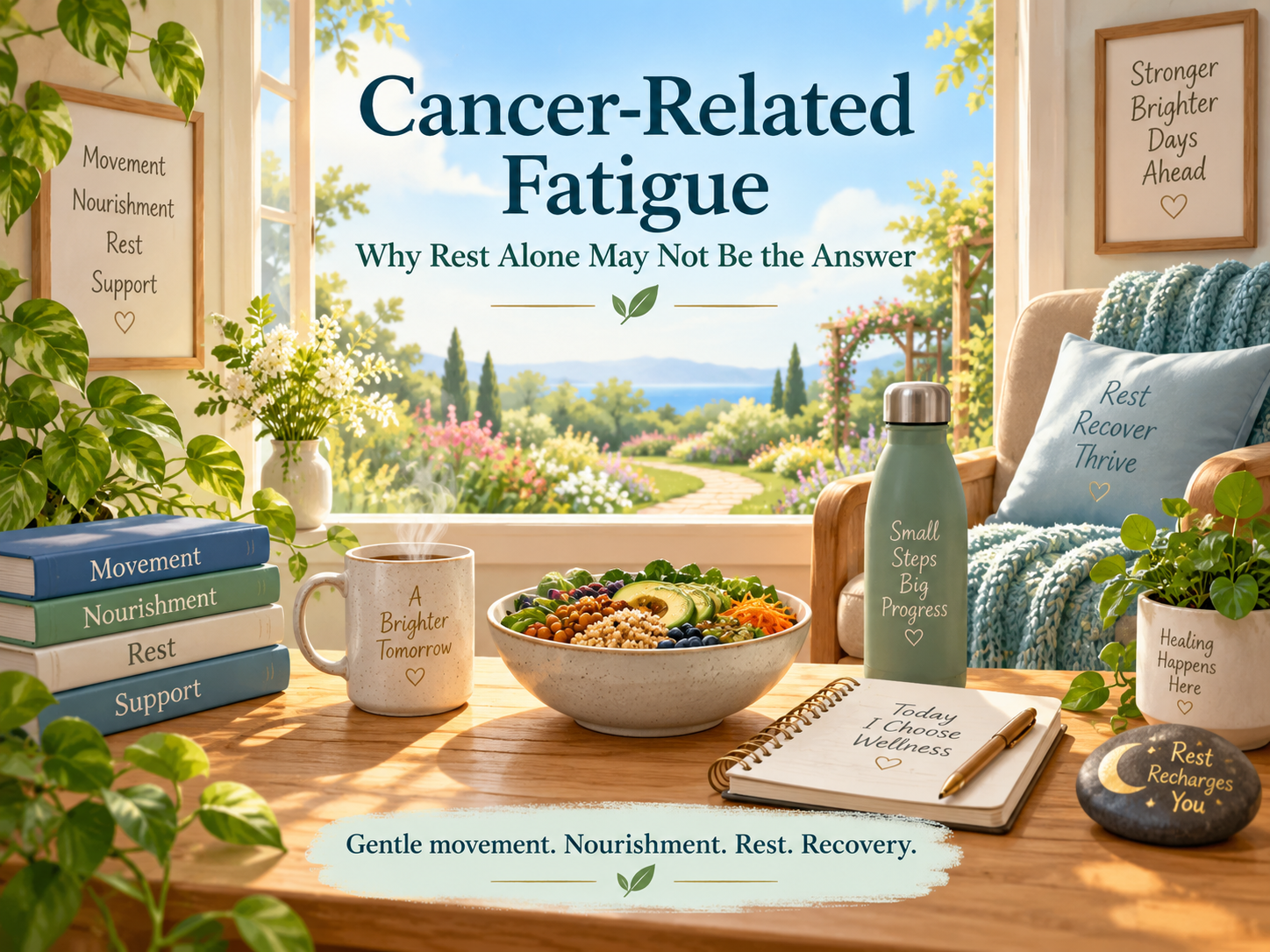
Cancer-Related Fatigue: Why Rest Alone May Not Be the Answer
Imagine waking up after a full night of sleep and feeling as though you never rested.
You stand up, get dressed, and walk into the kitchen. Before breakfast is finished, you already need to sit down. Taking a shower feels like exercise. A short conversation requires concentration. Activities that once happened automatically now require planning.
Someone who loves you may say, “You need to get more rest.”
The advice is well-intended, but cancer-related fatigue is not the same as the tiredness we experience after a busy day. Ordinary tiredness usually improves with sleep and recovery. Cancer-related fatigue may persist despite rest and can affect the body, mind, emotions, concentration, relationships, work, and ability to perform everyday activities.
It can occur during treatment and may continue after treatment has ended.
This does not mean a person should ignore the need for rest or force the body to work harder. It means that fatigue deserves a thoughtful, individualized approach. Sometimes the answer includes rest. Sometimes it also includes medical evaluation, carefully chosen movement, rehabilitation, nutrition, better sleep, emotional support, and mind-body practices such as Qigong.
Fatigue Is a Symptom, Not a Personal Failure
People going through cancer treatment may feel frustrated with themselves because they cannot accomplish what they once did. They may compare today's energy with the energy they had before their diagnosis.
It is important to understand that cancer-related fatigue is not laziness, weakness of character, or a lack of motivation. It is a recognized medical symptom associated with cancer and its treatment.
The National Cancer Institute describes cancer-related fatigue as persistent physical, emotional, or cognitive exhaustion that is out of proportion to recent activity, interferes with normal functioning, and is not completely relieved by sleep or rest.
A patient may experience fatigue in several ways:
Physical heaviness or weakness
Difficulty beginning or completing activities
Poor concentration or “brain fog”
Reduced motivation
Irritability or emotional exhaustion
Feeling tired immediately after waking
Needing much longer to recover after activity
The experience is real, even when other people cannot see it.
Why Cancer-Related Fatigue Happens
There is rarely one explanation. Fatigue can result from the cancer itself, surgery, chemotherapy, radiation, immunotherapy, hormone therapy, or other medicines. It may also be intensified by:
Anemia
Infection
Pain
Poor sleep
Dehydration
Reduced appetite or inadequate nutrition
Loss of muscle and physical conditioning
Anxiety or depression
Breathing, heart, thyroid, kidney, or other medical problems
Medication side effects
Because fatigue has many possible causes, it should not automatically be accepted as something the patient simply has to endure.
Tell your oncology team when fatigue begins, when it is worst, what makes it better or worse, and how it affects daily life. The team may need to review medications, examine sleep and nutrition, assess emotional health, or order tests to look for treatable causes.
Sudden or rapidly worsening fatigue—especially with fever, chest pain, trouble breathing, fainting, confusion, unusual bleeding, severe dizziness, or a fast or irregular heartbeat—requires prompt medical attention. Follow the oncology team's specific instructions about symptoms and fever thresholds.
The Fatigue–Inactivity Cycle
When people feel exhausted, they naturally move less. This may be necessary on difficult days, but long periods of inactivity can lead to loss of muscle, reduced endurance, stiffness, poor balance, and declining confidence.
A cycle can develop:
Fatigue leads to less movement. Less movement leads to weakness. Weakness makes ordinary activity require more energy. This creates even more fatigue.
Breaking this cycle does not require strenuous exercise. It requires finding the right amount of movement for the person's health, treatment, and energy level.
For one person, this may mean a short walk. For another, it may mean standing up from a chair several times, completing physical-therapy exercises, or practicing gentle seated Qigong.
The appropriate plan may change from day to day. The goal is not to prove how much you can do. The goal is to preserve function without overwhelming the body.
What Current Guidelines Recommend
In 2024, the American Society of Clinical Oncology and the Society for Integrative Oncology updated their guideline for managing fatigue in adults with cancer. After reviewing 113 randomized clinical trials, the guideline recommended exercise, cognitive behavioral therapy, mindfulness-based programs, and tai chi or Qigong to reduce fatigue during treatment.
For people who have completed treatment, exercise, cognitive behavioral therapy, and mindfulness-based programs are also recommended. Other approaches may be appropriate in specific circumstances.
This is important because it confirms that movement and mind-body care are not merely pleasant additions. They can be meaningful parts of evidence-informed fatigue management.
However, no program should be imposed on every patient in the same way. Exercise and Qigong should be adapted when someone has recently had surgery, has low blood counts, neuropathy, poor balance, heart or lung disease, bone metastases, infection risk, lymphedema, severe weakness, or other medical concerns.
Always ask the oncology or rehabilitation team what is safe.
How Qigong May Help
Qigong combines gentle movement, breathing, posture, focused awareness, and relaxation. It can be practiced standing or seated and adapted for people with limited strength or mobility.
For someone experiencing cancer-related fatigue, Qigong may provide a bridge between complete inactivity and conventional exercise. Movements can be slow and brief, and the person can stop before becoming depleted.
Qigong may also help address the emotional side of fatigue. A calm breathing rhythm and focused attention can reduce the feeling of constantly fighting the body. The practice invites the patient to listen, adjust, and participate consciously in recovery.
This does not mean Qigong cures cancer or removes every cause of fatigue. Its role is supportive: helping the person move, breathe, relax, preserve function, and reconnect with the body.
Rest Strategically, Not Automatically
Rest remains important, but more rest is not always better. Long daytime naps may make nighttime sleep more difficult, while staying in bed for extended periods may contribute to weakness.
A more useful approach may be to alternate manageable activity with planned recovery.
Consider these ideas after receiving medical guidance:
Learn your energy pattern. Notice the time of day when you feel strongest and reserve it for the most important task.
Use short intervals. A five-minute walk or several minutes of Qigong may be more manageable than one long session.
Stop before exhaustion. Do not wait until your energy is completely gone before resting.
Choose priorities. Decide what truly needs your energy and allow others to help with the rest.
Protect nighttime sleep. Keep daytime naps short if longer naps interfere with sleeping at night.
Track changes. A simple daily record of energy, sleep, pain, activity, and treatment days may reveal useful patterns.
Nourishment and Hydration Matter
Fatigue can make shopping, cooking, and eating difficult. At the same time, inadequate nutrition and dehydration may make fatigue worse.
There is no single diet that is right for every person with cancer. Treatment may change appetite, taste, digestion, swallowing, blood sugar, or nutritional needs. An oncology dietitian can help create a plan based on the person's diagnosis, treatment, weight, symptoms, and medical conditions.
Patients should also tell their oncology team about vitamins, herbs, energy products, and supplements. “Natural” does not automatically mean safe, and some products may interact with treatment or other medicines.
The Emotional Weight of Fatigue
Fatigue can be isolating. A person may cancel plans, struggle to work, depend on others, or feel guilty for not doing more. Family members may misunderstand because the patient looks well from the outside.
Anxiety, depression, fear, and sleep disruption can also intensify fatigue. Counseling, cognitive behavioral therapy, mindfulness, support groups, and appropriate medical care may help.
Asking for emotional support is not a sign of weakness. It is part of treating the whole person.
A Gentle Daily Framework
There is no universal routine, but the following framework may help begin a conversation with your healthcare team:
Morning: Before getting out of bed, take three slow breaths and notice your energy level. Decide what is most important today.
Movement: At an approved time, walk or practice gentle Qigong for a few minutes. Use a chair or stable support when needed.
Nourishment: Eat and drink according to your medical and nutritional guidance. Accept help with meals when energy is limited.
Rest: Take intentional breaks before you become completely exhausted.
Evening: Reduce stimulation, practice relaxed breathing, and prepare the body for sleep.
Communication: Record meaningful changes and share them with your healthcare team.
Work With Your Body
Cancer-related fatigue can make a person feel that the body has become an obstacle. I prefer to look at the body as something we must learn to work with.
Some days the body may need more rest. On another day, it may benefit from a short walk, gentle Qigong, nourishing food, physical therapy, meaningful conversation, or quiet time in nature.
Recovery is not a straight line, and progress cannot always be measured by how much you accomplish.
The goal is not to push through fatigue or surrender completely to it. The goal is to understand it, evaluate it, and respond in a way that protects strength, function, and quality of life.
If you are going through cancer treatment or continuing to experience fatigue after treatment, speak with your healthcare team. Ask whether exercise, rehabilitation, cognitive behavioral therapy, mindfulness, Qigong, nutritional support, or other evidence-informed options might be appropriate for you.
If you would like to learn how Medical Qi Gong and individualized supportive care may complement your cancer treatment and recovery, visit www.energymedicineflorida.com or call or text 305-407-0120.
--
Sherwood S Swartz AP, MMQ, DMQ, DOM.
AKA Dr. Wu Dhi
