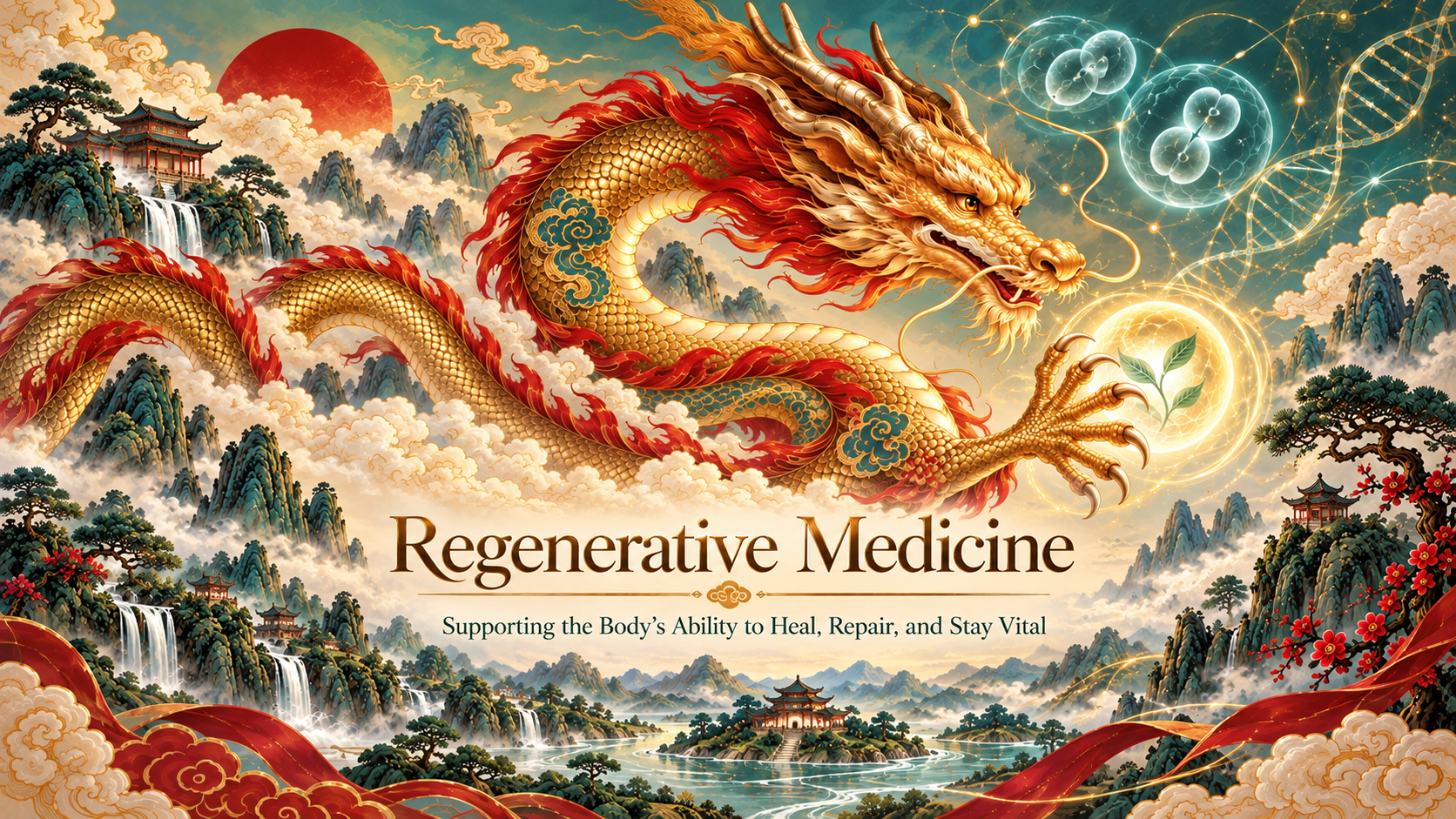
Regenerative Medicine: Supporting the Body’s Ability to Heal, Repair, and Stay Vital
For most of my professional life, I have been interested in one fundamental question:
How can we help the body maintain its energy, function better, recover more effectively, and avoid aging before its time?
That question has guided much of my work over the past four decades.
It has led me through acupuncture, Medical Qigong, Tai Chi and Qigong, ozone therapy, NLP, nutritional medicine, rehabilitation, deep-tissue work, movement therapy, and many other approaches designed not simply to suppress symptoms, but to support the body's own ability to adapt, repair, and restore balance.
Today, that same philosophy is becoming increasingly important in the developing field of regenerative and restorative medicine.
For patients dealing with chronic pain, old injuries, declining mobility, slow recovery, fatigue, or simply the feeling that their body is not functioning the way it once did, these new approaches open an important conversation.
Instead of asking only:
“What can I take for this?”
I believe we should also be asking:
“What can we do to help the body function better?”
A Different Way of Looking at Healing
Regenerative medicine is a broad field that includes platelet-rich plasma (PRP), orthobiologics, stem-cell research, extracellular signaling, tissue engineering, cellular therapies, biomaterials, and other approaches being studied for their potential roles in tissue repair and recovery.
What interests me most is the philosophy behind it.
Rather than focusing exclusively on suppressing pain or controlling symptoms, regenerative medicine asks whether we can improve the biological environment in which healing takes place.
Can we improve circulation?
Can we encourage healthier tissue response?
Can we support movement and rehabilitation?
Can we influence inflammation and cellular communication?
Can we combine newer regenerative approaches with acupuncture, Medical Qigong, ozone therapy, nutrition, exercise, sleep, rehabilitation, and conventional medical care?
These are the questions that continue to interest me both personally and professionally.
My Personal Experience
I haven't simply studied regenerative medicine.
I have explored it myself.
I have received regenerative treatments involving stem-cell-based approaches, exosomes, and platelet-rich plasma.
Following some of these treatments, I noticed an improvement in my overall energy.
I also subsequently underwent medical stress testing and saw improvement in my scores.
I cannot claim that one treatment alone produced those changes. Health is influenced by many factors, and an individual experience is not scientific proof.
But when I notice a meaningful improvement in how I feel and also see encouraging objective changes, I pay attention.
At this stage of my life, maintaining my strength, mobility, cardiovascular function, mental clarity, and energy is extremely important to me.
And I believe many of my patients are looking for exactly the same thing.
They are not simply asking:
“How do I get rid of this pain?”
They are asking:
“How do I keep functioning?”
“How do I remain active?”
“How do I recover from an injury?”
“How can I protect my independence as I grow older?”
Those are the questions that guide much of the work we do at Energy Medicine Florida.
PRP and Musculoskeletal Recovery
One regenerative treatment that I have personally found particularly interesting is platelet-rich plasma, or PRP.
I have received PRP for back pain and also during my recovery from a fractured wrist, and I was very pleased with my experience.
PRP is prepared from a patient's own blood. The blood is processed to concentrate platelets, and that preparation is then introduced into a targeted area.
Platelets are known for their role in blood clotting, but they also contain numerous proteins and signaling molecules involved in the body's response to injury.
PRP has been studied extensively in orthopedic and sports-medicine settings for a variety of tendon, ligament, joint, muscle, and other musculoskeletal problems.
It is part of a larger area known as orthobiologics—the use of biological materials and preparations in an effort to support musculoskeletal healing and recovery.
For someone living with chronic back discomfort, an old sports injury, joint problems, tendon irritation, or slow recovery after an injury, I believe it is worth learning about all appropriate options rather than assuming medication or surgery is always the only path available.
Exosomes and Cellular Communication
I have also personally received exosome treatments and felt that I responded positively.
Exosomes are tiny extracellular vesicles released by cells. They carry proteins, lipids, nucleic acids, and other signaling materials between cells.
Scientists are very interested in their role in cellular communication and continue to investigate their potential significance in areas such as tissue repair, inflammation, wound healing, and neurological research.
This remains a rapidly developing field, and much is still being learned.
That is one reason I believe it is so important to remain curious without becoming careless.
New medicine should be explored thoughtfully, monitored carefully, and judged by results whenever possible.
Ozone, Neurotherapy, and Prolozone in My Practice
In my clinical work at Energy Medicine Florida, I have also spent considerable time exploring therapies that may complement the body's recovery process, including acupuncture, Medical Qigong, ozone-based therapies, neurotherapy, deep-tissue treatment, lymphatic approaches, rehabilitation strategies, and prolozone.
Many people who come to my office are not looking for another medication.
They may already have seen several practitioners.
They may have persistent pain, an old injury, restricted movement, scar tissue, muscle tension, fatigue, or a feeling that their body has simply stopped recovering the way it once did.
My approach is not to treat every person with the same technique.
I start by asking:
What is preventing this person's body from functioning at its best?
Sometimes the problem is mechanical.
Sometimes it involves muscular imbalance.
Sometimes circulation may be part of the picture.
Sometimes the nervous system has remained irritated after an injury.
Sometimes scar tissue is limiting movement.
Sometimes stress, sleep, nutrition, or deconditioning is slowing recovery.
And very often, several of these factors are happening at the same time.
That is why I prefer an integrative approach.
Your First Visit Is About Understanding the Whole Picture
When someone comes into my office, I am not interested only in the name of their diagnosis.
I want to understand how the problem is affecting their life.
Can you walk comfortably?
Can you sleep through the night?
Can you exercise?
Can you bend, turn, lift, or reach?
Are you afraid to move because you expect pain?
Has your energy declined?
Have you stopped doing activities you once enjoyed?
These questions matter because successful treatment should ultimately improve your ability to live your life.
Depending upon your condition, a treatment plan may involve one or a combination of approaches, including acupuncture, Medical Qigong, ozone-based therapies, neurotherapy, lymphatic treatment, soft-tissue work, movement recommendations, and other supportive therapies within my scope of practice.
The goal is not to force the body.
The goal is to create the best possible conditions for the body to respond.
Beyond the “Pain Pill or Surgery” Conversation
There are times when medication is necessary.
There are times when surgery is absolutely appropriate.
There are also situations in which conventional medical treatment can be lifesaving.
I do not believe regenerative or integrative medicine should be positioned against conventional medicine.
I believe the future lies in combining the best tools available.
The Body Has an Extraordinary Capacity for Repair
After more than four decades of working with patients, I remain amazed by the human body.
The body is never simply sitting still.
Cells communicate.
Bones remodel.
Muscles repair.
Blood vessels adapt.
The nervous system reorganizes.
Wounds close.
The immune system responds.
Every day, your body is attempting to maintain balance and repair the wear and tear of living.
The purpose of good medicine, in my view, is to understand those processes and support them whenever possible.
That is what continues to fascinate me about regenerative medicine.
Continuing to Learn
Regenerative medicine is developing very rapidly, which makes continuing education extremely important.
This October, the American Academy of Stem Cell Physicians (AASCP) is scheduled to hold its Ninth Annual Fall Scientific Session, October 2–4, 2026, at the Hyatt Regency Miami.
The meeting brings together healthcare professionals interested in regenerative medicine, stem-cell science, clinical research, and advanced treatment approaches. You may have more options than you realize.
At Energy Medicine Florida, my approach is to look at the whole person and determine which therapies may be appropriate for your individual situation.
The goal is to maintain as much strength, movement, energy, independence, and quality of life as possible during those years.
Ready to Explore Your Options?
If you are dealing with persistent pain, an old injury, decreased mobility, slow recovery, or declining energy, you may have more options than you realize.
At Energy Medicine Florida, I take an individualized approach to care. We look at the whole person, review what you have already tried, and discuss which integrative or regenerative therapies may be appropriate for your needs and goals.
The goal is not simply to reduce symptoms. It is to help you maintain as much strength, movement, energy, independence, and quality of life as possible.
Call or text 305-407-0120 to schedule a consultation.
— Dr. Wu Dhi
Energy Medicine Florida
