The Full Moon, Qi, and the Art of Letting Go
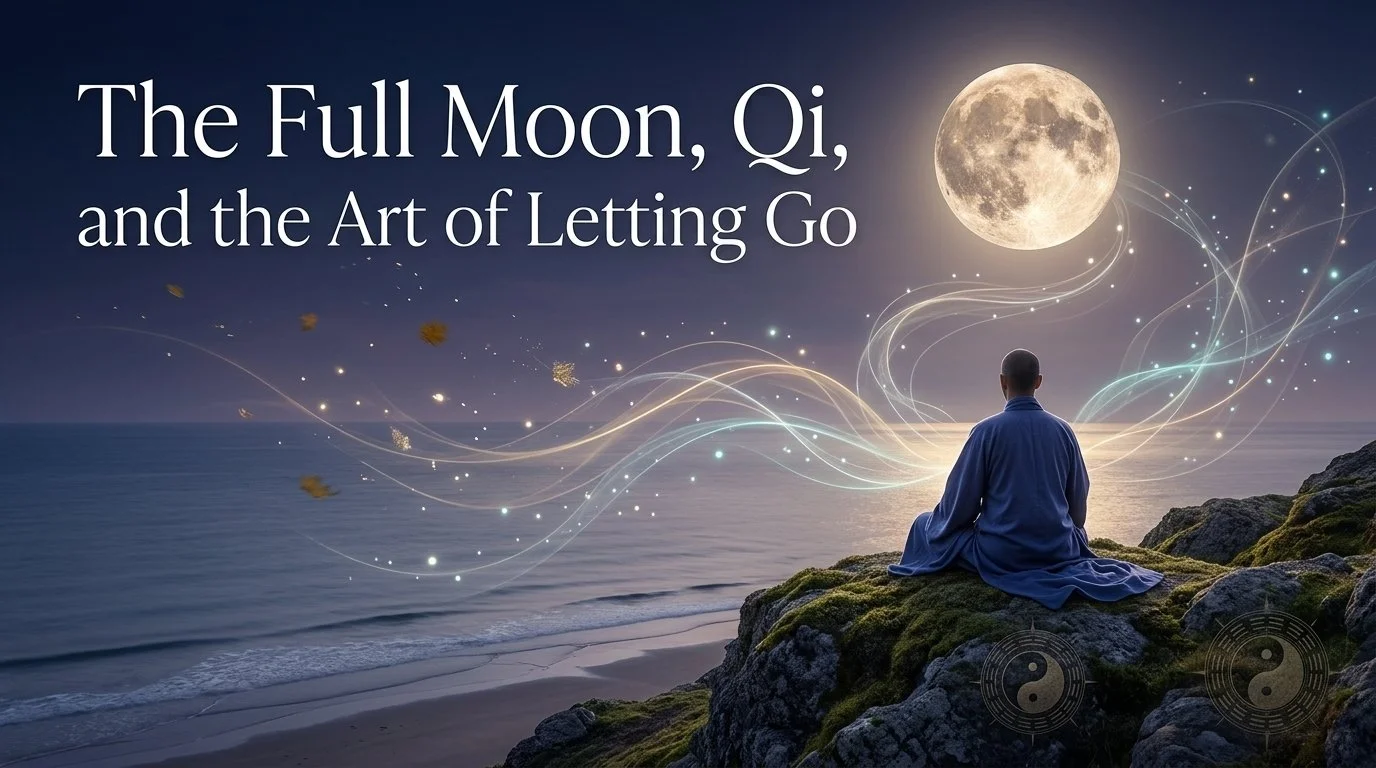
For thousands of years, human beings have looked toward the Moon and recognized something familiar in its changing face.
It grows. It becomes full. It begins to diminish. Eventually, it disappears from our sight, only to begin the cycle again.
Perhaps this is one of the reasons the Moon has played such an important role in spiritual traditions, medicine, agriculture, meditation, and human culture throughout history. Its changing phases remind us of something we sometimes forget: nothing in nature remains in one state forever.
We are no different.
There are times in our lives to grow and expand. There are times to become active and productive. There are times to rest. And there are also times when we need to release what we have been carrying.
The full moon can be a beautiful reminder to stop for a moment and ask ourselves a simple question:
Where is my energy going?
The Full Moon and Our Health
There are many beliefs about the effect of the full moon on the human body.
People sometimes tell me they sleep differently around the full moon. Others experience vivid dreams, increased energy, restlessness, emotional sensitivity, or simply a feeling that something is different.
Scientifically, however, we should be careful about claiming that the full moon directly causes major changes in our physical or mental health.
Research has not consistently demonstrated that the full moon causes significant changes in blood pressure, circulation, psychiatric illness, human behavior, or other major physiological processes.
I believe we can respect both science and ancient wisdom.
We do not have to claim that the Moon is controlling our bodies in order to recognize the value of living with greater awareness of the cycles of nature.
The lunar cycle can become a kind of natural calendar—a regular opportunity to stop, evaluate ourselves, and reconnect with our bodies, minds, emotions, and spirit.
Understanding Yin and Yang
Traditional Chinese Medicine teaches us that nature is constantly moving between Yin and Yang.
Yang represents qualities such as activity, warmth, expansion, movement, and outward expression.
Yin represents qualities such as quietness, coolness, nourishment, reflection, restoration, and inward movement.
Neither is better than the other.
Health depends upon their relationship.
We cannot remain Yang all the time. If we are constantly working, exercising, talking, thinking, worrying, producing, and pushing ourselves forward without adequate restoration, eventually the body asks us to slow down.
Likewise, we cannot remain completely Yin. There are times when we must move, act, create, communicate, and participate in the world.
The wisdom is learning when to cultivate and when to release.
The Moon provides us with a beautiful visual representation of this movement.
The new moon begins quietly in darkness. The light gradually increases as the Moon waxes. Eventually it reaches fullness. Then the process reverses. The light begins to diminish as the Moon wanes until another cycle begins.
Our lives follow similar patterns.
From Summer Yang Toward Autumn Yin
The August full moon occurs at an interesting seasonal point.
We may still be experiencing the heat and intensity of summer, especially in warmer climates, but nature has already begun preparing for the next season.
In Chinese medicine, summer represents a highly Yang period of the year. There is warmth, activity, growth, movement, and outward expression.
As we begin moving toward autumn, the energetic direction gradually changes.
The expansive energy of summer begins to contract.
Autumn is associated with the Metal element and, within the Five Element system, with the Lung and Large Intestine.
The Lung receives.
The Large Intestine releases.
Even in this simple relationship there is a profound lesson.
We must be able to take in what nourishes us and let go of what no longer serves us.
Think about breathing.
We inhale.
Then we exhale.
Imagine trying to inhale continuously without ever breathing out.
It would be impossible.
Yet emotionally and mentally, many of us do exactly that.
We accumulate responsibilities, memories, disappointments, anger, possessions, relationships, worries, and expectations.
We keep taking things in.
But how often do we consciously let something go?
The Emotional Side of Letting Go
Within Traditional Chinese Medicine, the Lung is traditionally associated with grief.
This doesn't mean that sadness automatically creates Lung disease, or that every Lung problem is caused by grief. Chinese medicine is much more nuanced than that.
But the association provides us with an interesting way of thinking about our emotional lives.
Grief is part of being human.
So are disappointment, anger, fear, loneliness, and regret.
The goal of an energetic practice should not be to pretend these emotions don't exist.
In fact, suppressing an emotion is very different from releasing it.
Sometimes we have to acknowledge something before we can let it go.
During meditation or Qi Gong, an old memory may suddenly appear. A person we haven't thought about for years may enter our mind. We may recognize anger that we thought we had resolved.
Instead of immediately pushing the thought away, we can observe it.
Take a breath.
Allow the body to soften.
And then ask:
Do I still need to carry this?
Sometimes the answer will be yes. There may still be something to learn or something that requires our attention.
But sometimes the answer is simply no.
And then we can begin the process of letting go.
The Lesson of the Lunar Eclipse
The August 2026 full moon was particularly interesting because it coincided with a very deep partial lunar eclipse.
More than 96 percent of the Moon entered the Earth's dark central shadow.
For a period of time, nearly the entire illuminated Moon was obscured.
Whether or not you attach spiritual meaning to an eclipse, I believe there is a wonderful metaphor here.
When the Earth's shadow moves across the Moon, the Moon itself has not disappeared.
It is still there.
We simply cannot see its light in the same way.
I think this happens to us as well.
There are periods in life when our own light seems to disappear.
We may experience illness.
We may lose someone we love.
A relationship may change.
We may experience financial difficulties, disappointment, fear, or uncertainty.
We may even begin questioning the direction of our lives.
During these times it is easy to believe that something essential has been lost.
But perhaps it hasn't disappeared at all.
Perhaps it has simply moved temporarily into shadow.
And just as the Moon eventually emerges from the Earth's shadow, we too can emerge from difficult periods with greater understanding.
Sometimes darkness isn't the end of the journey.
Sometimes it is part of the journey.
Qi Gong and the Full Moon
If you practice Qi Gong, meditation, yoga, breathwork, or another form of energy cultivation, the full moon can become a useful monthly reminder to return to your practice.
I don't believe we need to make the practice complicated.
In fact, some of the most powerful practices are very simple.
Begin by walking slowly for several minutes.
Feel your feet touching the Earth.
Become aware of your breathing.
Then stand comfortably with your feet approximately shoulder-width apart. Relax the knees. Allow the shoulders to drop. Let the chest soften.
Place your attention in the lower dantian—the energetic center located in the lower abdomen.
Don't force your breath.
Simply breathe.
On the inhalation, imagine receiving what nourishes you.
On the exhalation, imagine releasing what you no longer need.
You might quietly repeat:
I receive what nourishes me.
I release what I no longer need.
Continue for several minutes.
Then become completely quiet.
Three Questions to Ask Yourself
During this quiet period, I like three very simple questions:
What am I holding onto?
What am I ready to release?
What deserves my energy now?
Don't force yourself to find an immediate answer.
This is important.
Meditation isn't an interrogation.
Sometimes we ask a question and the answer arrives tomorrow.
Sometimes it appears in a dream.
Sometimes it emerges during a walk, while gardening, or while sitting quietly several days later.
We create the space and allow the answer to come when it is ready.
Protect the Energy You Cultivate
There is another important part of Qi Gong practice that is sometimes overlooked.
When we meditate or practice Qi Gong, we are cultivating attention, calmness, breath, and what Chinese traditions describe as Qi.
But what happens after the practice?
If we immediately become angry, begin arguing, start yelling, or allow someone to provoke us into an intense emotional reaction, we may quickly lose the centered state we worked to develop.
Cultivating energy is only half of the practice.
Learning how to preserve it is equally important.
This doesn't mean becoming emotionally cold or refusing to respond when something needs to be addressed.
It means learning not to give away our internal balance unnecessarily.
Someone else's anger does not have to become our anger.
Someone else's anxiety does not have to become our anxiety.
Someone else's emotional storm does not have to become ours.
We can remain present without surrendering our center.
That is a very different kind of strength.
Closing the Practice
Whenever I practice Qi Gong or meditation, I believe it is important to close the practice rather than simply walking away while feeling energetically expanded.
Bring both hands to the lower abdomen.
Place one hand over the other.
Take several slow, comfortable breaths.
Allow your awareness to settle into the lower dantian.
Feel your feet.
Feel your body.
Become aware of your surroundings.
Gather your attention back into yourself.
I like to summarize the practice with four simple thoughts:
Gather the light.
Enter the shadow without fear.
Release what has finished.
Return the light to the lower dantian.
Living With the Cycles of Nature
The full moon does not need to control us for it to teach us something.
Nature is constantly demonstrating cycles.
Day becomes night.
Summer becomes autumn.
The tide comes in and goes out.
We inhale and exhale.
We wake and eventually sleep.
Our hearts contract and relax.
Everything moves.
Perhaps one of the secrets to health and longevity is learning not to fight every change.
There are times to cultivate.
There are times to expand.
There are times to become still.
And there are times to let go.
The next time you see the full moon, take a few minutes and simply become quiet.
Feel your breath.
Feel your feet touching the Earth.
Bring your awareness to the lower dantian.
And ask yourself:
Where is my energy going—and is that where I truly want it to go?
The answer may tell you more than you expect.
Interested in Learning Qi Gong?
If you're interested in learning more about Qi Gong and how it can become part of your own health, wellness, and longevity practice, I offer private one-on-one instruction as well as small group classes.
Classes are approximately one hour and can be tailored to your individual needs, experience, physical ability, and personal goals.
You do not need previous Qi Gong experience. Whether you are beginning for the first time or would like to deepen an existing practice, we can develop a session around what you would like to accomplish.
If you're interested in learning more or scheduling a private or group Qi Gong class, feel free to call me at 305-407-0120.
— Dr. Wu Dhi
Sherwood S Swartz AP, MMQ, DMQ, DOM.
AKA Dr. Wu Dhi
