A Curious Observation During Bloodletting: What Can Differences in Blood Appearance Tell Us?
One of the greatest gifts of practicing medicine for more than four decades is realizing that every patient has something new to teach us. No matter how many years of experience we accumulate, the human body continues to surprise us.
Recently, I was treating a patient suffering from chronic lower back pain and persistent muscle cramping. After completing my evaluation, I decided to incorporate therapeutic bloodletting as part of her treatment.
What happened next immediately caught my attention.
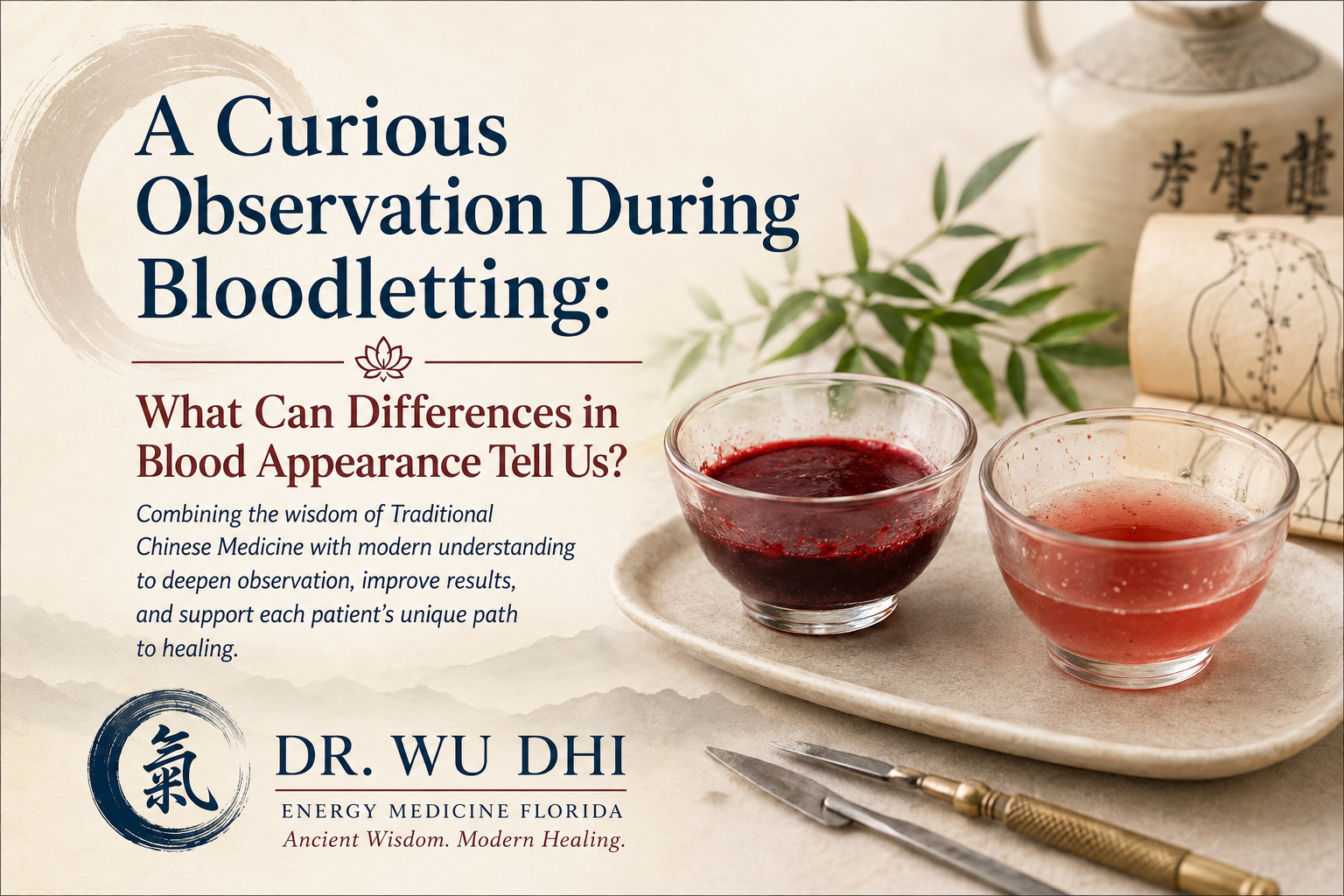
When I performed bloodletting on one leg, the blood was bright red, thick, and flowed slowly. When I treated the opposite leg only moments later, the blood appeared much thinner, lighter, and noticeably more watery. Seeing such a dramatic difference in the same patient, during the same treatment session, made me stop and think.
What could explain such a difference?
Looking Through the Lens of Traditional Chinese Medicine
Traditional Chinese Medicine has observed the qualities of blood for thousands of years. Although modern laboratory science measures blood differently, classical Chinese physicians carefully observed color, flow, temperature, and consistency as part of understanding the patient's overall pattern.
One possibility is Blood Stasis.
Blood Stasis refers to impaired circulation of Blood and Qi. When circulation becomes sluggish, patients often experience chronic pain, fixed pain, stiffness, old injuries that never completely healed, or muscle tightness. In clinical practice, blood associated with stagnation may sometimes appear thicker or slower moving.
Another possibility involves Heat within the Blood. Heat can increase circulation while simultaneously altering the characteristics of the blood. Depending on the individual pattern, practitioners may observe bright red blood, increased warmth, or signs of inflammation.
On the other hand, thinner blood may reflect a very different energetic pattern. Blood Deficiency, Qi Deficiency, or an imbalance of body fluids may influence how tissues are nourished and how circulation presents clinically. Differences between the right and left sides of the body may also suggest that one meridian system is functioning differently than the other.
Of course, these observations are only one piece of the diagnostic picture. In Chinese medicine, they are always considered alongside the pulse, tongue, symptoms, medical history, and overall constitutional pattern.
A Modern Medical Perspective
Modern physiology offers several explanations that are equally worth considering.
Blood viscosity can be influenced by hydration, circulation, local vascular resistance, tissue perfusion, venous pressure, temperature, and the patient's overall cardiovascular health. Small differences in the depth of a puncture or the amount of tissue pressure can also influence how blood appears during a procedure.
Certain medical conditions—including chronic venous insufficiency, peripheral vascular disease, and other circulatory disorders—may also contribute to differences in local blood flow.
Because of this, the appearance of blood alone should never be used as a diagnostic tool. Instead, it should be viewed as one observation among many that may encourage further clinical evaluation when appropriate.
The Art of Observation
Medicine has always been both an art and a science.
Long before MRIs, CT scans, ultrasounds, and laboratory testing, physicians depended on observation. They examined the skin, listened carefully to the patient's story, observed posture and movement, assessed the pulse, and paid attention to subtle changes that others might overlook.
Today's technology is extraordinary, and I rely on it whenever necessary. Yet I also believe that careful observation remains one of the most valuable clinical skills any healthcare practitioner can develop.
Sometimes the smallest detail leads us to ask the most important questions.
Bringing Ancient Wisdom and Modern Science Together
Throughout my career, I have tried to integrate the best of both worlds. Traditional Chinese Medicine offers thousands of years of clinical observation, while modern medicine provides sophisticated diagnostic tools and scientific understanding.
Rather than viewing these approaches as competitors, I believe they complement one another.
Every patient deserves individualized care. Every symptom deserves thoughtful evaluation. And every clinical observation—whether expected or unexpected—offers another opportunity to learn.
This patient's treatment reminded me that medicine continues to evolve through curiosity, careful observation, and an open mind. Even after decades in practice, I still find myself learning something new every week.
That, to me, is one of the greatest joys of being a physician.
Have you observed unusual differences in tissue response, circulation, or healing during treatment? I'd love to hear your clinical experiences and insights.
Have questions about Medical Qi Gong, acupuncture, or natural approaches to health? I'd be happy to help. Contact me to schedule a consultation or explore my classes and educational resources. You can call my office at 305-407-0120.
To your health,
Dr. Wu Dhi
--
Sherwood S Swartz AP, MMQ, DMQ, DOM.
AKA Dr. Wu Dhi
