Yin, Yang and Beyond: The Ancient Understanding of Balance, Health and Change
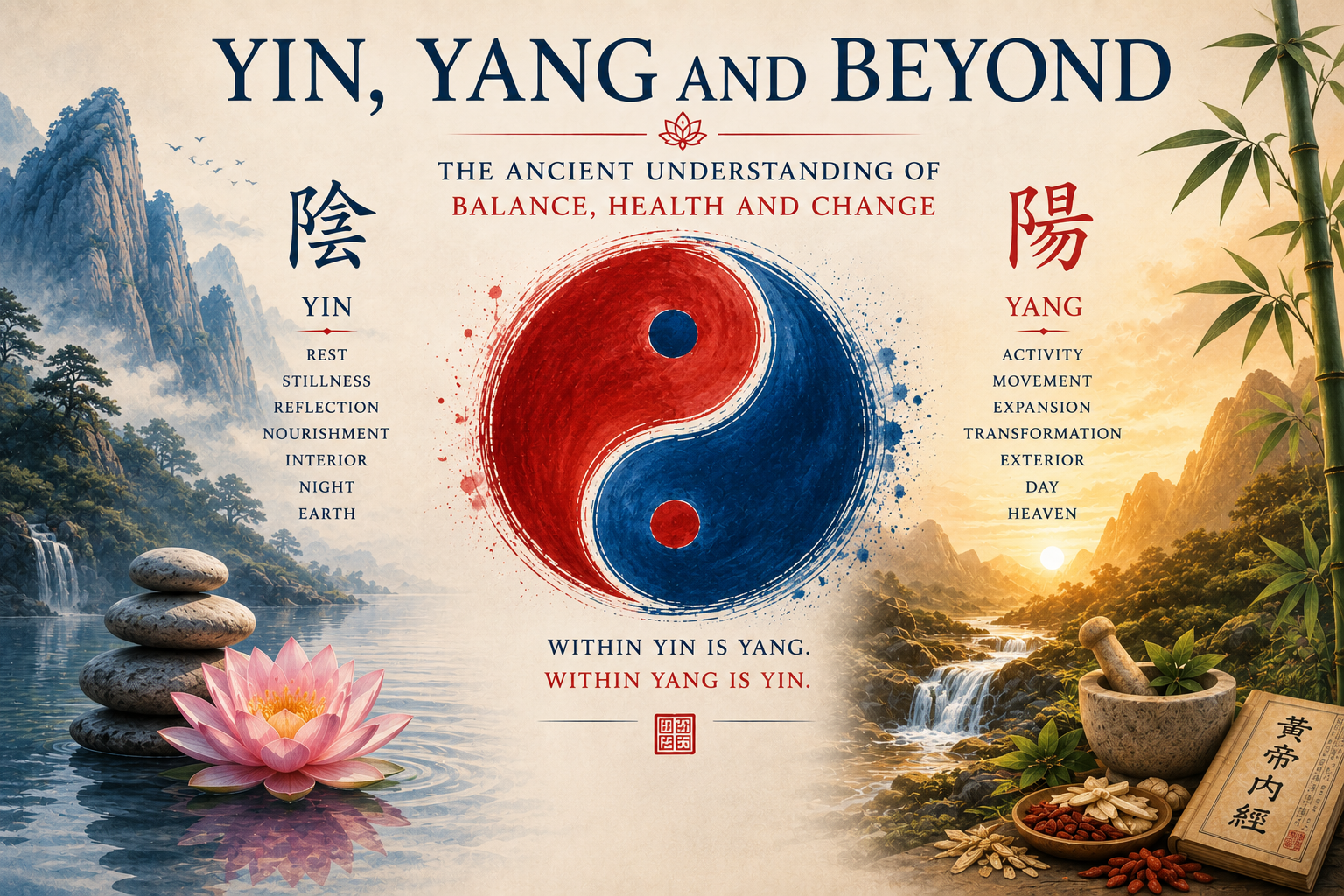
Almost everyone recognizes the Yin-Yang symbol, yet relatively few people understand the depth of what it represents.
The familiar circle contains two intertwined forms: one dark and one light. Within the dark Yin portion is a small circle of white Yang, and within the white Yang portion is a small circle of dark Yin.
This seemingly simple image contains one of the foundational ideas of Chinese philosophy and Traditional Chinese Medicine.
Yin and Yang are not enemies.
They are complementary forces that define one another, depend upon one another, and continually transform into one another.
There can be no concept of light without darkness, no activity without rest, no exterior without an interior, and no heat without our understanding of cold.
The ancient Chinese physicians observed these relationships in nature and recognized that the same principles could be observed within the human body.
What Are Yin and Yang?
Traditionally, Yang is associated with qualities such as:
Activity
Heat
Light
Movement
Expansion
Exterior
Upper portions of the body
Heaven
Daytime
The masculine principle
Yin is associated with:
Rest
Cold
Darkness
Stillness
Contraction
Interior
Lower portions of the body
Earth
Nighttime
The feminine principle
These associations should not be interpreted too literally.
Yang does not mean “man,” and Yin does not mean “woman.” Men and women both contain Yin and Yang. Every organ and physiological process can also be discussed in terms of its Yin and Yang aspects.
What matters is the relationship.
Each Contains the Other
One of the most important features of the Yin-Yang symbol is the small circle of the opposite color contained within each side.
Within Yin exists Yang.
Within Yang exists Yin.
This reminds us that nothing in nature is completely one or the other.
At midnight, when darkness has reached its greatest expression, the movement toward sunrise has already begun.
At noon, when the sun is at its highest, the movement toward evening has begun.
Winter eventually becomes spring.
Summer eventually becomes autumn.
Activity eventually requires rest.
Life itself is movement between these complementary forces.
Yin and Yang Within the Human Body
Chinese medicine applies these observations to physiology.
The exterior of the body is relatively Yang compared with the interior.
The upper body is relatively Yang compared with the lower body.
Function and movement are relatively Yang, while physical substance and nourishment are relatively Yin.
However, these relationships are always relative.
Something can be Yin in one relationship and Yang in another.
This is an important point because Chinese medicine does not view the body as a collection of isolated parts. It looks at relationships and patterns.
The Eight Principles of Chinese Medicine
One of the fundamental diagnostic frameworks in Traditional Chinese Medicine is known as the Eight Principles.
They consist of four complementary pairs:
Yin and Yang
Interior and Exterior
Cold and Heat
Deficiency and Excess
These principles help practitioners organize the signs and symptoms presented by an individual.
Is the pattern primarily internal or external?
Does it demonstrate cold or heat?
Is there something excessive that needs to be reduced, or is something deficient that needs to be supported?
Ultimately, these distinctions can also be understood within the larger framework of Yin and Yang.
Excess and Deficiency
This is where Yin-Yang theory becomes particularly interesting.
Heat does not always mean there is simply “too much Yang.”
Imagine Yin as the body's cooling, nourishing and moistening aspect.
If Yin becomes insufficient, Yang may become relatively unrestrained. The resulting pattern can produce signs traditionally described as deficiency heat.
Conversely, if Yang becomes deficient, the body's warming and transformative functions may become inadequate, producing signs associated with deficiency cold.
Therefore, two people who appear to have similar symptoms may have very different underlying patterns.
And if the patterns are different, the traditional treatment principles may also be different.
This individualized approach is one of the characteristics that has fascinated me throughout my years of practicing Chinese medicine.
The Heart, Kidneys, Fire and Water
The relationship between the Heart and Kidneys beautifully illustrates this philosophy.
The Heart is traditionally associated with the Fire element.
The Kidneys are associated with the Water element.
It might seem that Fire and Water should oppose each other, but in a healthy system they communicate and support balance.
Classical theory describes Kidney Water as ascending to nourish and restrain Heart Fire, while Heart Fire descends to participate in warming and supporting the functions associated with the Kidneys.
This relationship is sometimes described as the communication or harmony between Heart and Kidney.
Once again, health emerges not from one force defeating another, but from communication between them.
The Six Divisions
The Six Divisions are another classical framework, particularly associated with the Shang Han Lun.
They are:
Tai Yang — Greater Yang
Yang Ming — Yang Brightness
Shao Yang — Lesser Yang
Tai Yin — Greater Yin
Shao Yin — Lesser Yin
Jue Yin — Terminal Yin
These should not be confused with the Eight Principles.
Historically, the Six Divisions provided physicians with a sophisticated way of understanding evolving patterns of illness and the relationships among different functional systems.
They demonstrate once again that Chinese medicine was concerned not merely with naming a disease, but with understanding how a pattern develops and changes.
Yin and Yang Are Always Moving
Perhaps the greatest misunderstanding about Yin and Yang is the idea that health means achieving a perfect 50/50 balance.
Nature doesn't work that way.
Morning becomes increasingly Yang as the sun rises.
Evening becomes increasingly Yin.
Summer expresses more Yang.
Winter expresses more Yin.
There are times in our lives when activity is appropriate and times when rest is necessary.
The goal is not mathematical equality.
The goal is appropriate relationship and the capacity to adapt.
Yin and Yang Beyond Medicine
I believe this ancient philosophy has something to teach us beyond the treatment room.
We live in a culture that frequently emphasizes Yang qualities: doing, achieving, producing, moving, exercising and accomplishing.
But perpetual activity without adequate rest eventually becomes unsustainable.
The opposite is also true. Rest without movement becomes stagnation.
Strength needs softness.
Speaking needs listening.
Giving needs receiving.
Expansion needs contraction.
Even our breath demonstrates the principle.
We inhale.
We exhale.
Neither is more important.
Try holding onto either one indefinitely and you quickly discover why both are necessary.
Finding Balance in Everyday Life
After more than four decades of practicing acupuncture and Medical Qi Gong, I have come to appreciate Yin and Yang less as an abstract philosophy and more as something we experience every day.
When we work, we eventually need to rest.
When the weather becomes extremely hot, we naturally seek cooling foods, shade and water.
When we have been inactive for too long, the body asks us to move.
The body is constantly communicating with us.
The question is whether we are paying attention.
The wisdom of Yin and Yang reminds us that health isn't necessarily a fixed destination. It is an ongoing process of responding, adjusting and adapting.
The ancient symbol says something profound through a remarkably simple image:
Within darkness there is the beginning of light.
Within activity there is the need for rest.
Within Yin exists Yang.
Within Yang exists Yin.
And neither can exist without the other.
Perhaps true balance is not standing perfectly still between two opposites.
True balance is developing the ability to move gracefully between them.
If you would like to explore how these ancient principles may apply to your own health and well-being, I invite you to schedule a private consultation.
Dr. Wu Dhi
Energy Medicine Florida
305-407-0120
— Dr. Wu Dhi
--
Sherwood S Swartz AP, MMQ, DMQ, DOM.
AKA Dr. Wu Dhi
