Don’t Let Others Blow Your Qi: Protecting the Energy You Cultivate
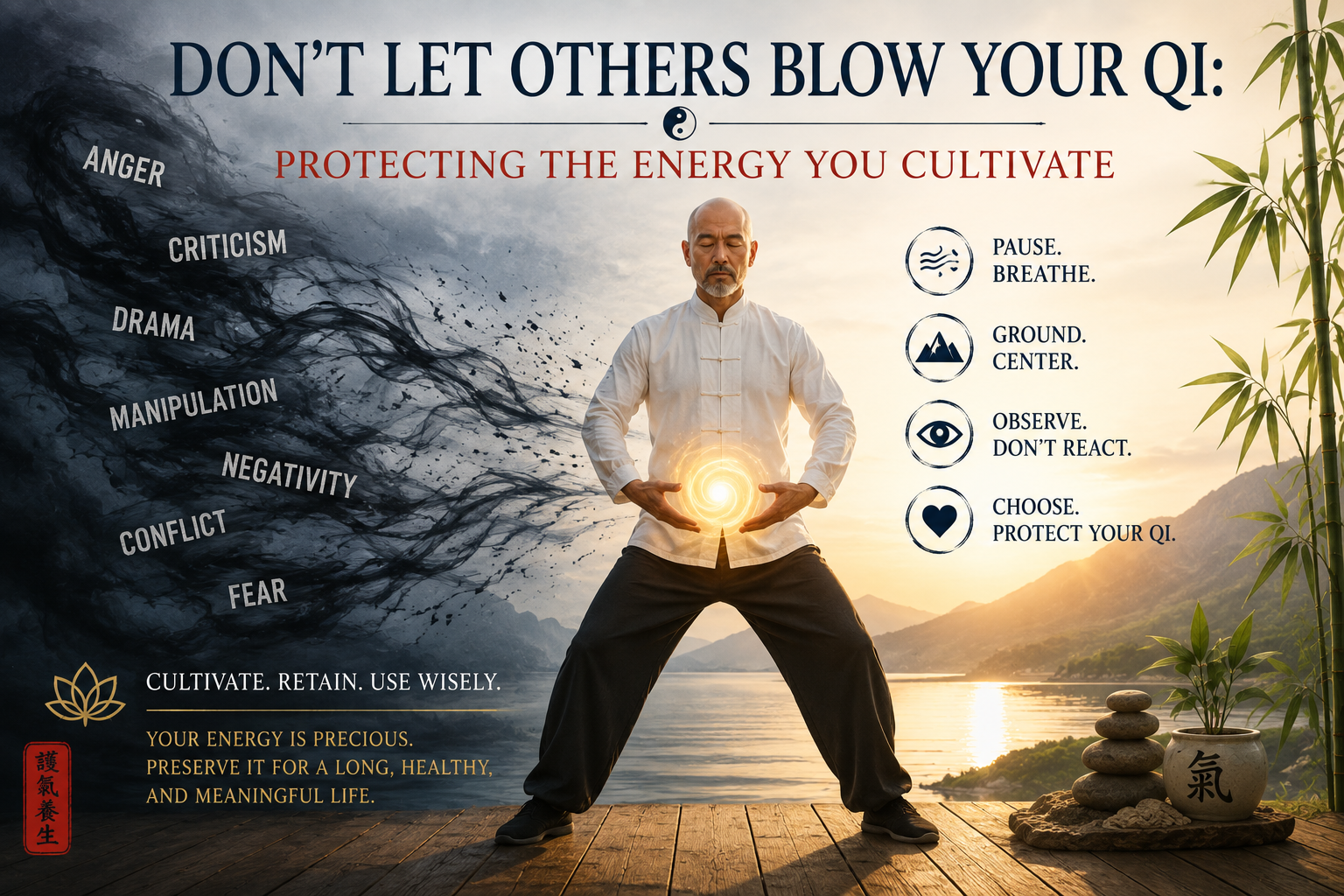
Don’t Let Others Blow Your Qi: Protecting the Energy You Cultivate
Ever Spend Days Building Your Energy, Only to Lose It in a Single Moment?
For more than 45 years, I have been deeply involved in longevity practices, meditation, Medical Qi Gong, Taoist exercises, Buddhist teachings, yoga, and the cultivation of internal energy. Throughout those years, I have learned that building energy is only one part of the practice. The greater challenge is learning how to retain it.
We may spend hours, days, or even years cultivating greater awareness, vitality, focus, and inner peace. Then one angry outburst, impulsive decision, or emotional confrontation can scatter much of what we worked so hard to develop.
This is why I often remind my students and patients of a simple principle:
Accumulation is important. Retention is everything.
In Chinese philosophy, the life-force energy moving through us is called Qi. We cultivate Qi through breathing exercises, meditation, Qi Gong, yoga, acupuncture, proper nutrition, sleep, time in nature, and conscious living. When our Qi is balanced, we may feel calmer, clearer, stronger, and more connected to life.
But energy must be managed wisely. Cultivating more energy without developing emotional stability can be like increasing the voltage in a system that has not yet learned how to contain it.
What Happens After Deep Internal Practice?
After an intensive meditation, Qi Gong practice, spiritual retreat, or healing experience, people often feel unusually open and sensitive. The mind may be quieter, the senses sharper, and the nervous system more responsive. Some people feel peaceful and grounded, while others may feel temporarily vulnerable, restless, emotional, or overstimulated.
This is why experienced teachers frequently advise students to move slowly after deep internal work. We may encourage them to remain quiet, eat mindfully, walk gently, avoid unnecessary conflict, and give the body time to integrate the experience.
The practice does not necessarily end when the meditation ends. The period afterward is part of the practice too.
I witnessed two experiences that taught me how important this period of integration can be.
A Lesson in Caracas
During a two-day meditation retreat in Caracas, Venezuela, the participants were instructed to remain quiet and grounded during the lunch break. One student ignored those instructions and hurried away from the retreat.
She became involved in a minor automobile accident and erupted into an intense screaming fit. From my perspective as her teacher, it appeared that the calm and energy she had cultivated during the retreat were suddenly redirected into anger and emotional reactivity.
Instead of carrying the benefits of the retreat into the rest of her life, she released much of that momentum in a single uncontrolled moment.
A Difficult Experience in Colorado
At another intensive retreat in Colorado, a student was visibly anxious and was encouraged to remain on-site until she felt settled. Instead, she got into her Jeep and drove away. She subsequently rolled the vehicle and was hospitalized with multiple concussions.
I would never claim that meditation or cultivated Qi caused her accident. Automobile accidents have many possible causes. What remained with me, however, was the danger of making an impulsive decision while emotionally unsettled and immediately after an intense internal experience.
Both situations reinforced the same lesson: after powerful spiritual or energetic work, we must respect the process of integration. We should not assume that feeling highly energized means we are automatically centered, calm, or ready to react to the demands of the outside world.
How Emotional Reactivity Scatters Your Energy
You do not have to attend an intensive retreat to experience this pattern.
Perhaps you begin your morning with meditation, breathing exercises, prayer, yoga, or Qi Gong. You feel centered and clear. Then someone criticizes you, sends an upsetting message, cuts you off in traffic, or draws you into an argument. Within seconds, your breathing changes, your muscles tighten, your heart beats faster, and your mind becomes consumed by the conflict.
The peaceful energy you cultivated has now become fuel for the reaction.
In everyday language, people sometimes describe certain individuals as “energy vampires.” I use this expression as a metaphor, not as a medical diagnosis or a claim that someone can literally steal your energy. It describes people or situations that repeatedly provoke, exhaust, manipulate, or pull us away from our center.
Some people know exactly which emotional button to push. They may challenge your pride, question your intelligence, bring up an old wound, or pressure you to respond immediately. If you take the bait, they begin controlling the direction of your attention and behavior.
The most effective protection is not building a wall around yourself. It is developing enough awareness that another person cannot easily control your inner state.
The Sacred Pause
When you feel the urge to react, practice what I call the sacred pause.
Before speaking, sending the message, making the telephone call, or stepping on the accelerator, stop and take three slow breaths.
Bring your awareness into your lower abdomen, an area known in Taoist practice as the lower dantian. Feel your feet touching the ground. Relax your jaw and shoulders. Allow the first wave of emotional charge to pass before deciding what to do.
You can remember the practice through five simple words:
Pause: Do not react immediately.
Breathe: Take three slow, conscious breaths.
Ground: Feel your feet and bring your attention to your lower abdomen.
Observe: Notice the emotion without becoming the emotion.
Choose: Respond in a way that protects your health, dignity, and energy.
This does not mean suppressing your feelings or allowing others to mistreat you. Healthy boundaries are essential. The difference is that a boundary established from clarity is usually more effective than a reaction driven by rage, fear, or panic.
Five Ways to Protect the Energy You Cultivate
1. Allow Time for Integration
After meditation, Qi Gong, acupuncture, bodywork, or another deep practice, give yourself a few quiet minutes before returning to a demanding environment. Walk slowly, drink water, eat something nourishing if appropriate, and avoid rushing.
2. Do Not Make Important Decisions While Emotionally Charged
Strong emotion narrows our perspective. Unless immediate action is required for safety, allow your mind and body to settle before driving, arguing, signing an agreement, ending a relationship, or sending a message you may later regret.
3. Protect Your Attention
Attention is one of your most valuable forms of energy. Be selective about the conversations, media, conflicts, and people to which you give it. Not every provocation deserves a response.
4. Return to the Lower Dantian
When your energy rises into the chest or head during stress, bring your awareness back to the lower abdomen. Breathe slowly and imagine the energy settling downward like sand falling to the bottom of a clear glass.
5. Use Your Energy Constructively
Qi is meant to circulate and support life. Direct it toward healing, movement, creativity, service, teaching, meaningful work, and loving relationships. Conserving energy does not mean becoming passive. It means using your life force deliberately.
Longevity Is More Than Living Longer
For the last 45 years, longevity has been one of the central themes of my work. Longevity is not simply adding more years to life. It is preserving enough physical, mental, emotional, and spiritual vitality to participate fully in those years.
Diet, exercise, sleep, medical care, and appropriate supplements may all play important roles. But we should not overlook the energy consumed by chronic anger, resentment, fear, worry, and unnecessary conflict.
Every emotional outburst has a physical component. Breathing changes. Muscles contract. Stress hormones are released. The cardiovascular and nervous systems respond. Learning to regulate our reactions is therefore not merely a spiritual idea—it is also a practical part of caring for the body.
True mastery is not measured by how peaceful we are when everything is quiet. It is measured by our ability to hold our center when chaos arrives.
The next time someone tries to provoke you, remember how long it took to cultivate your calm. Take the sacred pause. Honor the internal shift. Protect your hard work, and do not plow under your own harvest.
The energy you cultivate is precious. Preserve it so you can use it to heal, create, love, teach, serve, and live a longer, healthier, and more meaningful life.
Take an Active Role in Your Longevity
If you are ready to take a more active role in supporting your energy, health, and longevity, I invite you to learn more about my work at Energy Medicine Florida or schedule a private appointment by calling 305-407-0120.
--
Sherwood S Swartz AP, MMQ, DMQ, DOM.
AKA Dr. Wu Dhi
