The Five Spirits: Acupuncture, Inner Alchemy, and the Art of Longevity
Most people think of acupuncture as a treatment for pain.
You put a needle in a point, move the Qi, improve circulation, and hopefully the person feels better.
But after many years of working with Chinese medicine, I have come to see acupuncture as something much deeper.
Sometimes we are not simply treating a knee, a back, digestion, insomnia, or stress.
We are treating the person who lives inside that body.
This is where an ancient Taoist understanding of the Five Spirits becomes very interesting.
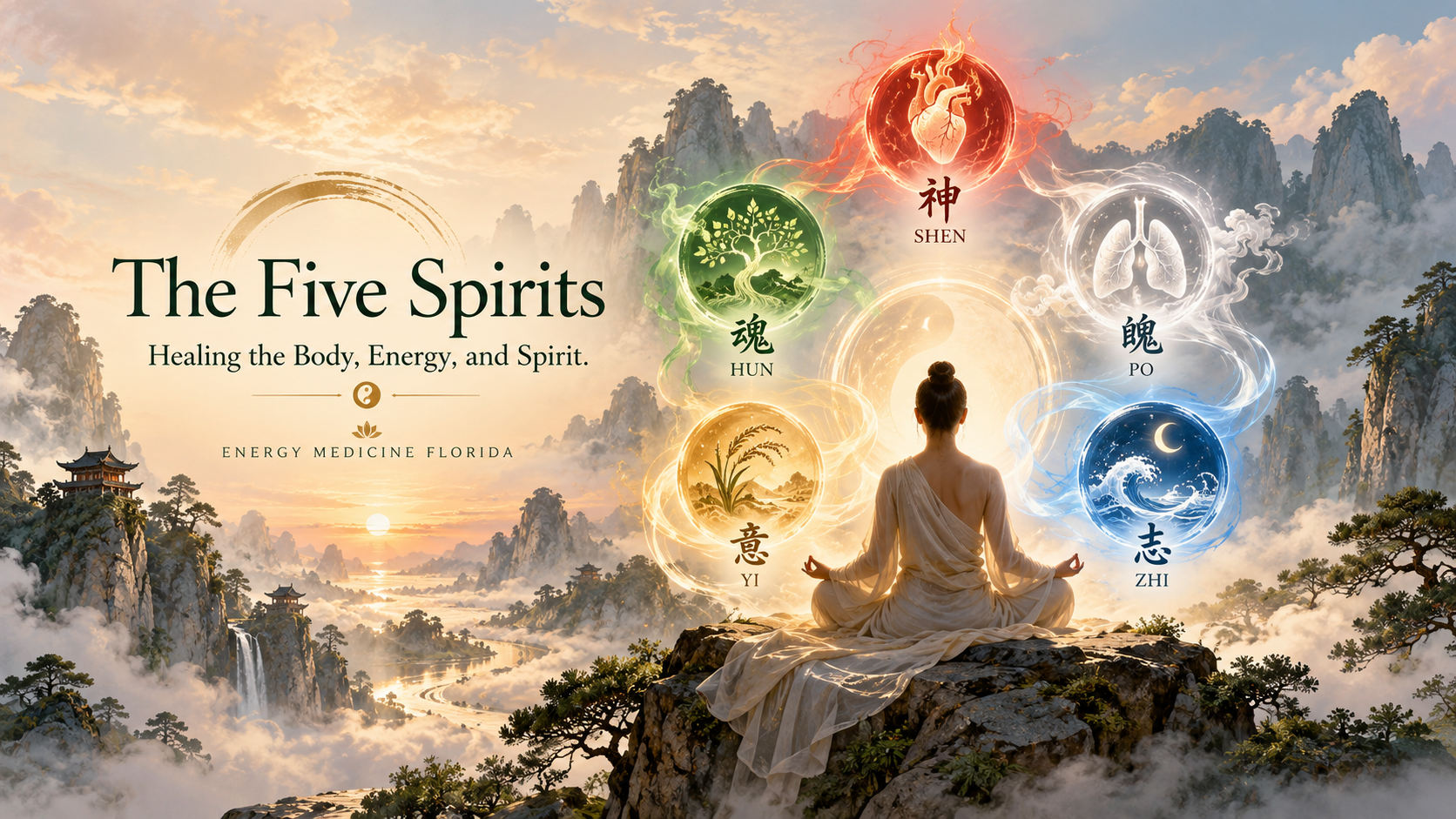
Chinese medicine traditionally associates five aspects of our mental, emotional, and spiritual life with five of the major Yin organs: Shen with the Heart, Hun with the Liver, Po with the Lungs, Yi with the Spleen, and Zhi with the Kidneys. This concept appears within the classical Chinese medical tradition and developed alongside broader Chinese ideas about cultivation of the body and spirit.
To me, these are not five little spirits floating around inside the body.
They are five different expressions of who we are.
Shen — The Spirit of the Heart
The Shen resides in the Heart.
It is our consciousness, our presence, our ability to connect, communicate, love, and experience joy.
You can sometimes see the Shen before a patient even says a word.
Look into the eyes.
Are they bright and present?
Or does the person seem scattered, anxious, distant, or exhausted?
In Chinese medicine, the Heart has traditionally been given a central role in organizing the other aspects of spirit.
When the Shen becomes quiet, there is a different quality to the person. The eyes become clearer. Breathing changes. The nervous system seems to settle.
Sometimes that is as important as treating the original complaint.
Hun — The Spirit of the Liver
The Hun is associated with the Liver.
I think of the Hun as the part of us that can dream.
Not only the dreams we have while sleeping, but our ability to see a future, imagine possibilities, create something new, and find direction in our lives.
It is movement.
It wants to grow.
When somebody feels completely stuck, frustrated, angry, or unable to imagine where their life is going, I often think about the Liver and the Hun.
The traditional literature associates Hun with the Liver and with aspects of vision, ideas, direction, and meaning.
Sometimes healing requires more than removing pain.
We have to help someone begin moving forward again.
Po — The Spirit of the Lungs
The Po belongs to the Lungs and is sometimes translated as the corporeal soul.
The Po is very connected to the physical body—to sensation, breathing, instinct, and our immediate experience of being alive.
It is also associated with grief and our ability to release.
That makes perfect sense to me.
We breathe in.
We receive.
We breathe out.
We let go.
Life itself continually asks us to do both.
When someone holds grief for years, you can sometimes see it in their posture and breathing. The chest becomes guarded. The breath becomes shallow. The person may feel as though they cannot completely release the past.
Chinese medical interpretations traditionally link the Po with the Lung, bodily sensation, and our embodied response to life.
Yi — The Spirit of the Spleen
The Yi is associated with the Spleen.
It represents thought, intention, concentration, and our ability to digest experience.
And I deliberately use the word digest.
The Spleen transforms food into nourishment in the traditional Chinese medical model, but psychologically we also have to digest what happens to us.
Some people cannot stop thinking.
The same thought keeps going around and around.
Chinese medicine calls this tendency toward excessive pensiveness or rumination an imbalance that can involve the Spleen system.
A healthy Yi allows us to think clearly, learn from an experience, and then move on.
Zhi — The Spirit of the Kidneys
The Zhi resides in the Kidneys.
Zhi is will.
It is perseverance.
It is the deep internal force that says:
Keep going.
The Kidneys in Chinese medicine are also closely associated with Jing—our Essence, constitution, development, aging, and reproductive vitality.
That makes the relationship between the Kidneys, Zhi, and longevity particularly interesting.
Longevity is not simply about living another ten or twenty years.
What is the quality of those years?
Do you still have curiosity?
Purpose?
Will?
Energy?
A reason to wake up in the morning?
Traditional Chinese medicine connects the Zhi with the Kidney system and our capacity for determination and direction.
Acupuncture as Inner Alchemy
This brings us into what I call the alchemical side of acupuncture.
Historically, Taoist inner cultivation and Chinese medicine shared an interest in nurturing the organs, regulating Qi, cultivating the spirit, and preserving life. Taoist longevity traditions included breathing practices, movement, diet, meditation, and other forms of internal cultivation.
Inner alchemy was not simply about turning one physical substance into another.
The deeper idea was transformation.
Transforming agitation into stillness.
Fear into wisdom and gentleness
Grief into acceptance.Valor and courageous
Anger into direction and kindness
Scattered thinking into intention Balance and grounding
And ordinary awareness into greater consciousness.
When I use the phrase alchemical acupuncture, I am using it in this broader modern sense. It is not one universally standardized ancient acupuncture system. It is a way of approaching treatment in which the practitioner looks beyond symptoms and considers how acupuncture, intention, breath, awareness, and energetic cultivation might support the whole person.
The needles become more than mechanical instruments.
They become part of a conversation with the body's energetic system.
The Five Spirits Must Work Together
Imagine these Five Spirits sitting together around a table.
The Hun says, “This is where we could go.”
The Yi says, “Let me think about how we get there.”
The Zhi says, “I have the determination to continue.”
The Po says, “Stay here in the body and experience this moment.”
And the Shen sits at the center, bringing awareness to the whole experience.
When these different aspects of ourselves communicate well, there can be a sense of coherence.
When one becomes overwhelmed, the whole person may feel different.
This is one of the beautiful things about Chinese medicine.
It doesn't always ask:
Where is the disease?
Sometimes it asks:
Where has harmony been lost?
Spiritual Healing and Longevity
I believe this is also where spiritual healing and longevity meet.
You can eat wonderful food.
Take supplements.
Exercise.
Have your laboratory work done.
All of these things can be valuable.
But we also have to ask:
What are you carrying emotionally?
What have you never released?
What happened to your dreams?
What happened to your joy?
What gives your life meaning?
Where is your will?
And is your Spirit peaceful?
Traditional Taoist longevity practices were concerned not only with the physical body but with cultivation of mind, breath, Qi, and spirit. Historical scholarship describes Taoist practices aimed at nourishing the viscera and supporting longevity through breathing, movement, diet, and inner cultivation.
Modern medicine cannot tell us that balancing a particular “spirit” will add a certain number of years to someone's life. The Five Spirits remain a traditional philosophical and clinical framework rather than a scientifically established anatomy.
But I think they give us something valuable.
They remind us that health is more than the absence of disease.
Longevity is more than keeping the body alive.
It is preserving the light inside the body.
Keeping the Shen bright.
Allowing the Hun to dream.
Helping the Po breathe and release.
Keeping the Yi clear.
And strengthening the Zhi so that we continue walking our path.
Perhaps the old Taoists understood something that we occasionally forget:
The cultivation of a long life begins not only by taking care of the body.
It begins by taking care of the Spirit that lives within it.
Dr. Wu Dhi
Energy Medicine Florida
If you feel that stress, emotional patterns, loss of vitality, or simply the pressures of life have left you feeling out of balance, acupuncture, Medical Qigong, and energy medicine may offer another way of looking at your health.
To learn more or schedule an appointment, visit Energy Medicine Florida.
I especially like the “five spirits sitting around a table” section for your voice because it makes a very esoteric teaching immediately understandable. We could take this one step further and add a section on specific acupuncture points associated with each Spirit and how you might use the Five Spirits clinically, while keeping the article appropriate for patients rather than practitioners.
Yes I like the idea of add of few important points but Id rather focus on how trhe medical qi gong effects our spirit
Yes. I think that makes the article stronger. Rather than turning it into an acupuncture-point lesson, we can make Medical Qigong the bridge between the Five Spirits and healing—how breath, intention, movement, sound, visualization, and Qi regulation can affect our emotional and spiritual state.
I would replace the “Acupuncture as Inner Alchemy” section with something like this:
Medical Qigong and the Five Spirits
This is where Medical Qigong becomes especially important.
Acupuncture works with the body's energetic pathways from the outside through the acupuncture points. Medical Qigong approaches many of the same energetic relationships through breath, movement, intention, meditation, sound, and awareness.
In the traditional Chinese view, we are not simply exercising muscles when we practice Qigong.
We are working with Qi.
We are working with the organs.
And on a deeper level, we are working with the Spirit.
When I teach or practice Medical Qigong, I am often interested in what is happening underneath the physical symptom.
A person may come in saying:
“I can't sleep.”
“I have no energy.”
“My chest feels tight.”
“I can't stop worrying.”
“I feel stuck.”
Those statements may sound completely different, but Chinese medicine encourages us to look deeper.
What is happening to the Shen?
Has the Hun lost its direction?
Is the Po holding grief?
Is the Yi trapped in endless thinking?
Has the Zhi become weakened by fear, exhaustion, or years of struggle?
Medical Qigong gives us a way of working with these questions without always having to answer them intellectually.
Sometimes the body knows before the mind does.
Calming the Shen
The Shen is housed in the Heart.
When the Shen is disturbed, the person may feel restless, anxious, scattered, emotionally unsettled, or unable to become quiet inside.
One of the first things Qigong can teach us is how to become still.
Slow the breathing.
Relax the chest.
Feel the feet connected to the earth.
Bring the awareness back into the body.
When the body begins to settle, the mind often follows.
This is not about forcing yourself to become calm.
It is about creating the internal conditions where calmness can return naturally.
Freeing the Hun
The Hun belongs to the Liver and is associated with vision, direction, creativity, and our ability to move forward.
When Liver Qi becomes constrained in the traditional Chinese medical sense, people can feel frustrated, irritable, emotionally trapped, or simply stuck.
Qigong movement can be very useful here.
Turning the waist.
Opening the ribs.
Stretching the tendons.
Breathing into areas that have become tight.
Moving slowly and deliberately.
Sometimes physical movement helps create emotional movement.
The person begins to feel possibility again.
Helping the Po Let Go
The Po is associated with the Lungs and our physical, instinctive experience of life.
It is deeply connected with breathing.
That alone tells us something.
Every breath teaches the same lesson.
Receive.
Release.
Receive.
Release.
We cannot keep inhaling forever.
At some point, we have to let go.
Grief can sometimes feel like something we have been unable to exhale.
Medical Qigong breathing practices can help a person become aware of where they are holding tension and gradually allow the breath to become fuller and easier.
I have always felt that the lungs teach us one of life's great lessons:
We have to know what to hold and what to release.
Settling the Yi
The Yi belongs to the Spleen and relates to thought, concentration, intention, and contemplation.
Thinking is necessary.
But thinking without stopping becomes worry.
Many people today live almost completely in their heads.
The mind is planning tomorrow, replaying yesterday, checking the phone, answering messages, and solving problems all day long.
Qigong brings the awareness downward.
Into the breath.
Into the abdomen.
Into the feet.
Into the present moment.
Instead of thinking about the body, we begin feeling the body.
That simple change can be profound.
Strengthening the Zhi
The Zhi is associated with the Kidneys and our deepest will.
I think of Zhi as the quiet voice inside that says:
Continue.
It is not aggressive willpower.
It is deeper than that.
It is endurance.
Purpose.
The ability to stay on our path even when life becomes difficult.
In Chinese medicine the Kidneys are also connected with Jing, our Essence, and therefore with development, aging, vitality, and longevity.
This is one reason I believe practices that conserve energy, regulate the breath, calm unnecessary stress, and strengthen our internal awareness become increasingly valuable as we grow older.
We don't want to constantly spend our energy.
We also have to learn how to cultivate it.
Medical Qigong as Inner Alchemy
This is where Medical Qigong becomes a form of inner alchemy.
Alchemy means transformation.
We are taking one internal condition and gradually changing its quality.
Fear can become wisdom.
Anger can become direction.
Grief can become acceptance.
Worry can become clarity.
Restlessness can become stillness.
The goal is not to eliminate every emotion.
Emotions are part of being human.
The goal is to prevent ourselves from becoming imprisoned by them.
Through breathing, movement, meditation, visualization, sound, and intention, Medical Qigong gives us tools for participating in our own healing.
As Dr. Jerry Alan Johnson and other teachers of Medical Qigong have emphasized in their work, Chinese energetic medicine looks at the relationship between the physical body, energetic body, emotions, and spirit rather than treating them as completely separate worlds.
That has always made sense to me.
How can we separate the body from the person living inside it?
The Spirit and Longevity
When we speak about longevity, most people immediately think about diet, exercise, laboratory tests, supplements, and genetics.
All of those things can matter.
But I believe there is another question we should ask:
What is the condition of your Spirit?
Do you still have joy?
Do you still have curiosity?
Can you become quiet?
Can you let go?
Do you have something that gives your life meaning?
Can you still imagine something new?
Do you still have the will to move forward?
Medical Qigong cannot guarantee a longer life, and the Five Spirits should not be presented as anatomical structures recognized by modern science.
But these ancient teachings give us a beautiful framework for thinking about something modern medicine sometimes has difficulty measuring:
The quality of the person living inside the body.
Perhaps true longevity is not simply extending the number of our years.
Perhaps it is maintaining the Shen, Hun, Po, Yi, and Zhi so that those years continue to contain awareness, purpose, creativity, connection, and Spirit.
That, to me, is one of the deeper meanings of healing.
I think this direction sounds much more like your work because it moves beyond “which acupuncture point treats which Spirit” and explains what Medical Qigong is trying to cultivate in the person. We could still mention just three or four special acupuncture points near the end as supportive tools, without letting the article become overly technical.
Medical qi gong isdifferent than the exercise of qi gong . Medical qi gong is when the doctor is using his vitsl force Qi tro clear open and break up staganed energy . It also can renew the patients energy of qi with what is deficiant . this needs to be brought into the artical, there are prescriptive exercises to sustain and enhance thew patients health and well being
That distinction is important, and it changes the center of the article. In your work, Medical Qigong is not simply the patient doing Qigong exercises. It is a practitioner-directed treatment, followed by prescriptive exercises so the patient can continue the work between visits.
Here is the revised section in that direction:
Medical Qigong and the Five Spirits
There is an important distinction I want to make.
Medical Qigong is not the same thing as simply practicing Qigong exercises.
Qigong exercises can be very valuable. They use breathing, movement, posture, meditation, and intention to help a person cultivate and regulate their own Qi.
Medical Qigong, as I practice it, is different.
In a treatment, the practitioner works directly with the patient's energetic system. Within the traditional Chinese energetic model, the doctor uses cultivated Qi, intention, and specific treatment methods to help clear areas where energy has become stagnant, open areas that have become blocked, and support places where the patient's Qi appears weak or deficient.
This is an energetic form of medicine.
The practitioner is not simply telling the patient how to move or breathe. The practitioner is actively working with the energetic field of the patient.
From the traditional Medical Qigong perspective, we may be trying to disperse excess energy, break up stagnation, clear what does not belong, or strengthen an area that has become depleted.
Afterward, the patient may also be given prescriptive Qigong exercises.
These exercises are an important part of the treatment.
They are selected for that particular person's condition and are designed to help sustain the changes made during the treatment, strengthen weak areas, regulate the emotions, support the organs, and help the patient participate in maintaining their own health.
This is where Medical Qigong becomes particularly interesting when we look at the Five Spirits.
Treating More Than the Physical Body
A patient may come to me because of pain, fatigue, stress, insomnia, grief, anxiety, or simply because they do not feel like themselves anymore.
I may be looking at the physical problem, but I am also asking a deeper question:
What has happened to this person's energy and Spirit?
In the Taoist and Chinese medical traditions, the organs are not viewed only as pieces of physical anatomy.
They are also connected with different aspects of our consciousness.
The Heart houses the Shen.
The Liver is associated with the Hun.
The Lungs with the Po.
The Spleen with the Yi.
And the Kidneys with the Zhi.
When one part of this system becomes disturbed, the effect may be experienced physically, emotionally, or spiritually.
The Shen — Bringing the Spirit Home
The Shen is associated with the Heart.
When somebody has lived through prolonged stress, fear, trauma, grief, illness, or exhaustion, sometimes you can see that their Spirit is unsettled before they even tell you what is wrong.
It shows in the eyes.
It shows in the breathing.
It shows in the way the person enters the room.
In Medical Qigong treatment, part of the work may be to settle the energetic system so that the Shen can become quieter and more centered.
I sometimes think of this as helping the Spirit come home again.
The Hun — Restoring Movement and Direction
The Hun is connected with the Liver.
It relates to our ability to dream, envision possibilities, create, and move forward.
When energy becomes stagnant, the patient may feel stuck in much more than the physical body.
Life itself can begin to feel stuck.
Medical Qigong treatment may focus on clearing and moving stagnant energy while supporting a freer energetic flow.
When movement returns, people sometimes begin to experience themselves differently.
There can be a feeling of space again.
Possibility again.
Direction again.
The Po — Clearing and Releasing
The Po belongs to the Lungs and is closely connected with our physical experience of life.
It is also traditionally associated with grief and letting go.
There are times when people seem to hold experiences in the body long after the event itself has passed.
The chest may tighten.
The breathing changes.
The body seems to protect itself.
In Medical Qigong, the practitioner may work with the Lung field and related energetic pathways, helping to clear what is stagnant and encouraging the person to breathe and release more freely.
Then the patient may be given breathing or Qigong exercises to continue that process.
This becomes both treatment and education.
The practitioner begins the process, but the patient learns how to participate in maintaining it.
The Yi — Clearing the Mental Fog
The Yi is associated with the Spleen.
It relates to thought, concentration, intention, and our ability to process our experiences.
Sometimes people are exhausted not because they are physically doing too much but because their mind never stops.
They are continually thinking, planning, remembering, worrying, and replaying.
Within the traditional Chinese energetic model, this can weaken the Spleen system and disturb the Yi.
Medical Qigong treatment can be directed toward settling this excessive mental activity while strengthening and centering the person's energy.
Prescriptive exercises can then teach the patient how to bring awareness out of the head and back into the body.
The Zhi — Rebuilding the Deep Reserve
The Zhi belongs to the Kidneys.
It is connected with will, endurance, determination, and our deeper reserves.
This becomes very important when we speak about aging and longevity.
Some people are tired because they need sleep.
Others seem tired at a much deeper level.
They have used up so much physical, emotional, and mental energy over the years that they feel depleted.
Within Chinese medicine, the Kidneys and Jing are closely connected with our constitutional reserves, development, aging, and vitality.
In Medical Qigong, strengthening a deficient energetic system becomes an important part of treatment.
The practitioner may work to support depleted Qi, while the patient is given practices designed to conserve energy rather than constantly spending it.
This is one of the great lessons of longevity:
It is not enough to know how to use energy. We also have to know how to preserve, restore, and cultivate it.
Medical Qigong as Inner Alchemy
This is where Medical Qigong becomes an alchemical practice.
Alchemy is transformation.
We are attempting to change the internal environment.
Stagnation into movement.
Deficiency into greater vitality.
Agitation into stillness.
Fear into inner strength.
Grief into release.
Confusion into clarity.
The practitioner begins the process through treatment, but the patient also has a responsibility.
This is why prescriptive Qigong exercises are so important.
The patient may be given breathing practices, movements, visualizations, sounds, meditations, or other energetic exercises specifically chosen for their condition.
The treatment opens the door.
The exercises help the patient continue walking through it.
Over time, the patient is not simply receiving treatment.
They are learning how to cultivate themselves.
Health, Spirit, and Longevity
For me, this is where the Five Spirits become much more than an interesting ancient philosophy.
They give us another way of looking at health.
When someone comes into my office, I am not only interested in what hurts.
I want to know:
Where has their energy stopped moving?
Where are they depleted?
What are they holding?
What have they lost?
Where is their Spirit?
And what needs to be strengthened so they can move forward again?
Modern science does not currently establish Qi transfer or the Five Spirits as measurable anatomical systems, so I don't present these ideas as a substitute for conventional medical diagnosis or treatment.
I use them as part of the traditional energetic framework that has guided Chinese medicine and Medical Qigong for generations.
And after many years of practicing this work, I continue to come back to one simple idea:
A healthy life is not only about keeping the body functioning. It is also about keeping the Spirit alive within the body.
The Shen needs peace.
The Hun needs direction.
The Po needs to breathe and release.
The Yi needs clarity.
The Zhi needs strength.
And all five need to work together.
Perhaps that is one of the deeper secrets of longevity.
Not simply adding years to life.
But keeping Qi, consciousness, purpose, and Spirit present within those years.
This version makes the practitioner treatment itself central, while still explaining why you prescribe exercises afterward to help the patient sustain and build on the work.
This is all good ,now what i need is an artical to put all of this together so the lay person understands it. not to long but inviting so they casll and make an appointment
Absolutely. I’d make it warm, simple, and slightly mysterious—enough to introduce the Five Spirits and Medical Qigong without overwhelming the reader.
The Five Spirits: Healing the Body, Energy, and Spirit
Most people think of health as something physical.
We look at blood pressure, pain, digestion, sleep, energy levels, and lab work.
All of these things are important.
But in Chinese medicine, health has always been viewed as something more.
The body, energy, emotions, and Spirit are connected.
One of the oldest ways of understanding this connection is through what is called the Five Spirits.
In traditional Chinese medicine, five major organ systems are connected with different aspects of our emotional and spiritual life:
The Heart is connected with the Shen, our consciousness, joy, and inner presence.
The Liver is connected with the Hun, our dreams, vision, creativity, and ability to move forward.
The Lungs are connected with the Po, our breath, physical awareness, grief, and ability to let go.
The Spleen is connected with the Yi, our thinking, concentration, and ability to process life.
The Kidneys are connected with the Zhi, our willpower, endurance, vitality, and inner strength.
You do not have to understand Chinese medicine to recognize these experiences.
We have all felt emotionally stuck.
We have all carried grief.
We have all worried too much.
We have all felt depleted.
And sometimes we lose our direction, motivation, or sense of joy.
Chinese medicine looks at these experiences as part of the whole person, not as something separate from the body.
Where Medical Qigong Comes In
Medical Qigong is different from simply doing Qigong exercises.
During a Medical Qigong treatment, the practitioner works directly with the patient's energetic system.
Using cultivated Qi, focused intention, and traditional energetic techniques, the practitioner works to help clear stagnant energy, open blocked areas, disperse excess, and strengthen areas that appear weak or deficient.
The goal is to help the body's energy move more freely and restore greater balance.
Depending on the person, treatment may focus on physical discomfort, emotional stress, exhaustion, grief, or a general feeling that something is simply not right.
After treatment, I may also prescribe specific Qigong exercises, breathing practices, movements, or meditations for the patient to practice at home.
These exercises are chosen to help maintain and strengthen the changes we are working toward.
In this way, the patient becomes an active participant in their own healing.
Healing Is More Than Removing Symptoms
Sometimes a person comes into my office because their back hurts.
Another person cannot sleep.
Someone else is exhausted all the time.
Another person may be carrying grief, stress, or worry that has been there for years.
Of course, we look at the physical symptoms.
But I also ask:
Where is the energy stuck?
Where is the person depleted?
What are they holding onto?
What needs to be strengthened?
And what has happened to their Spirit?
This is the part of Chinese medicine that I find so fascinating.
The goal is not simply to chase symptoms.
It is to help bring the person back toward balance.
The Alchemy of Healing
In Taoist traditions, healing can also be viewed as a form of inner alchemy.
Alchemy means transformation.
Stagnation can become movement.
Exhaustion can become greater vitality.
Fear can become inner strength.
Grief can begin to release.
Restlessness can become stillness.
And a person who has felt disconnected from themselves may begin to feel present again.
This does not happen overnight, and Medical Qigong is not a replacement for appropriate medical care.
But it can offer another way of looking at health—one that recognizes that the physical body, emotional life, energetic system, and Spirit are deeply connected.
Health and Longevity
When we talk about longevity, we often think about living more years.
But I believe the better question is:
How well are we living those years?
Do we still have energy?
Joy?
Curiosity?
Purpose?
Inner strength?
Can we breathe deeply, let go of what no longer serves us, and continue moving forward?
To me, this is where the teachings of the Five Spirits become especially meaningful.
Longevity is not simply keeping the body alive.
It is keeping the Spirit alive within the body.
If you have been feeling tired, stressed, emotionally stuck, depleted, or simply not quite yourself, Medical Qigong and Chinese medicine may offer another way to look at what is happening.
At Energy Medicine Florida, I work with acupuncture, Medical Qigong, and other forms of energy medicine to help support the whole person—not just the symptom.
If you would like to experience this approach for yourself, I invite you to schedule an appointment.
Energy Medicine Florida
If you would like to experience this approach for yourself, I invite you to schedule a private consultation.
Call 305-407-0120 to schedule an appointment and begin exploring a deeper approach to health, balance, and longevity.
Sherwood S Swartz AP, MMQ, DMQ, DOM.
AKA Dr. Wu Dhi
