The Sacred Breath: The Lungs, the Po, and the Courage to Let Go
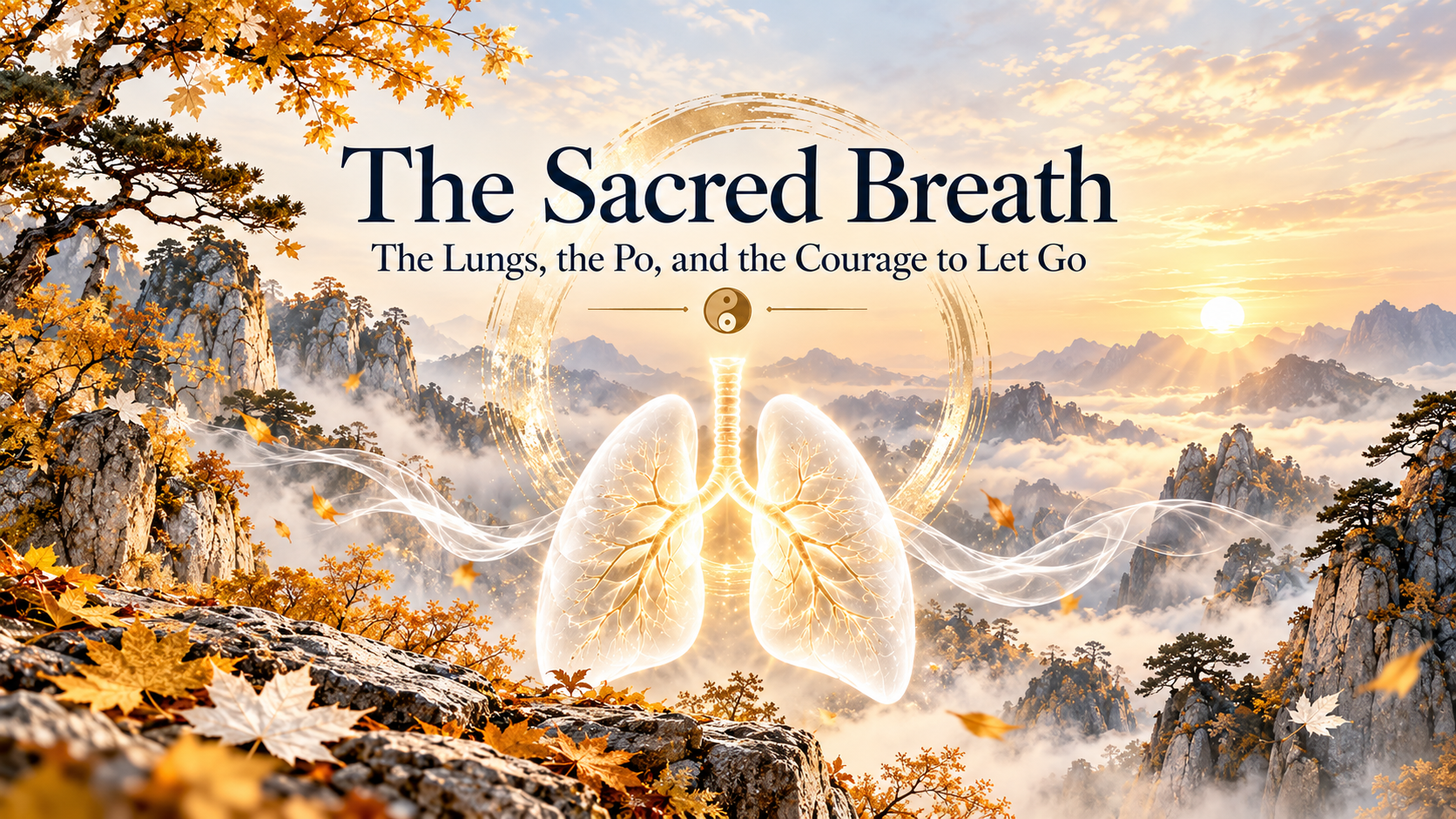
The first thing we do when we enter this world is take a breath. One of the last things we do before leaving this world is release a breath. Between those two moments, our entire life unfolds.
Think about that for a moment.
We can live without food for weeks. We can survive without water for several days, depending on the circumstances. But without oxygen, we have only minutes before the brain and other vital organs begin to suffer serious damage.
Our breath is that essential to life, yet how often do we stop and think about it?
We breathe approximately 20,000 times every day, usually without giving it a second thought. Breathing happens while we sleep, walk, work, eat, and dream. The lungs never take a vacation.
From a Western medical perspective, the lungs bring oxygen into the bloodstream and remove carbon dioxide. They work closely with the heart, brain, immune system, and nervous system to keep us alive. They also help regulate the body's acid-base balance and protect us from many of the particles and microorganisms we inhale.
But from the perspective of traditional Chinese medicine, the Lungs have an even deeper significance.
They are associated with the Metal element, the season of autumn, the color white, and the spirit known as the Po, sometimes called the corporeal soul.
The Lungs are also connected with grief, sadness, courage, dignity, righteousness, and our ability to let go of the past.
The Po: The Spirit of the Lungs
In Chinese medicine, the Po is one of the Five Spirits. While the Hun, associated with the Liver, is concerned with dreams, vision, and the movement of consciousness, the Po is closely connected with our physical existence.
The Po represents our instinctive awareness, bodily sensations, immediate emotional responses, and our experience of being alive in a physical body.
It is the part of our spirit that feels the world directly.
A beautiful sunset, the touch of a loved one, the fragrance of a flower, or the sensation of cool air entering the lungs are all experiences we can associate with the Po.
In traditional Chinese thought, the Po is associated with the body from the beginning of life and returns to the earth at death. The Hun, by contrast, is traditionally described as having a more ethereal nature.
This gives the Po a very special relationship with our first and last breaths.
The Po teaches us how to inhabit our bodies, experience the present moment, and accept the changing nature of life.
When the Po is balanced, a person may feel grounded, present, comfortable in their body, and connected with the world around them.
When disturbed, traditional Chinese medicine describes experiences such as sadness, excessive grief, emotional withdrawal, restlessness, and difficulty moving beyond painful experiences.
These are traditional energetic interpretations rather than medical diagnoses.
Grief and Sadness: The Emotions of the Lungs
All of us experience grief.
We grieve when someone we love dies, when a relationship ends, when we lose our health, or when life changes in ways we did not expect.
Sometimes we even grieve for the person we once were or the dreams that never came to pass.
In Chinese medicine, grief and sadness are closely associated with the Lungs. Traditional teachings describe excessive or prolonged grief as something that can weaken or constrain Lung Qi.
Have you ever noticed what happens to your breathing when you are deeply saddened?
Your chest may tighten. You may sigh repeatedly, feel a heaviness in your chest, or find yourself taking shallow breaths.
Modern physiology confirms that emotions can influence breathing patterns through the nervous system. Chinese medicine interprets this relationship through the movement of Qi.
But grief itself is not a disease. It is a natural part of loving and living.
I believe the real question is not how we can avoid grief, but how we can move through it without losing our connection to life.
Sometimes people carry their grief for years. They continue to function, go to work, and care for their families, but something inside remains unresolved.
In my work with acupuncture and Medical Qigong, I often invite people to become more aware of their breathing, their bodies, and the emotions they may be carrying.
We cannot simply erase grief, nor should we try. But we can create conditions that encourage relaxation, emotional awareness, and a healthier relationship with our feelings.
There is a difference between remembering someone with love and remaining trapped in the pain of losing them.
The Positive Virtues of Metal: Courage, Valor, and Righteousness
Chinese medicine also teaches that the organ systems have positive spiritual qualities.
For the Lungs and the Metal element, these include courage, valor, integrity, dignity, and a sense of righteousness.
Different classical and contemporary traditions emphasize somewhat different virtues, but they share an important principle: Metal gives us the strength to recognize what is valuable and act according to our principles.
Courage does not mean the absence of fear.
Courage is the ability to face fear, grief, uncertainty, or loss while continuing to live with purpose.
Valor is the willingness to stand for something greater than our immediate comfort.
Integrity means living according to our values, even when doing so is difficult.
And righteousness, in its healthiest expression, is not about judging other people. It is about knowing what is right for us and having the strength to honor it.
A balanced Metal personality can possess extraordinary inner strength.
Such a person may be disciplined, honorable, courageous, dependable, and deeply respectful of others.
There is often a quiet dignity about them.
But when these same qualities become excessive, discipline may turn into rigidity, righteousness into self-righteousness, and healthy standards into perfectionism.
One of the spiritual lessons of Metal is learning to maintain our principles without becoming imprisoned by them.
The Metal Personality: Order, Perfection, and the Search for Meaning
In Five Element theory, people are sometimes described according to the element that most strongly influences their constitution or temperament.
Someone with a pronounced Metal personality may appreciate order, structure, beauty, simplicity, and precision.
They often have high standards for themselves and sometimes for everyone around them.
They may be thoughtful, analytical, disciplined, organized, and concerned with doing things properly.
Many have a strong sense of justice and personal responsibility.
Metal personalities may also be deeply sensitive to beauty, particularly the beauty found in simplicity, nature, art, and ceremony.
Yet Metal has its challenges.
An imbalanced Metal personality may become overly critical, rigid, emotionally guarded, perfectionistic, or unable to forgive.
There may be a tendency to hold on to disappointments, past mistakes, or ideas about how life should have been.
A person can become so concerned with doing everything correctly that they forget how to enjoy life.
The spiritual work of Metal is to develop discernment without judgment, discipline without rigidity, and courage without aggression.
Of course, nobody is only one element. We all contain Wood, Fire, Earth, Metal, and Water. The elements are traditional ways of understanding patterns of experience, not fixed personality categories or scientifically validated personality tests.
The Large Intestine: The Partner of the Lungs
In Chinese medicine, the Lungs and Large Intestine are paired organs belonging to the Metal element.
The Lungs are considered Yin, while the Large Intestine is Yang.
Together, they offer a wonderful spiritual teaching about receiving and releasing.
The Lungs take in what we need. The Large Intestine eliminates what the body no longer requires.
Physiologically, these organs perform very different functions. The lungs exchange respiratory gases, while the large intestine absorbs water and electrolytes, supports the gut microbiome, and helps form and eliminate stool.
But symbolically, they express a similar principle.
Life requires both receiving and letting go.
Think of what happens when we hold on too tightly.
We may hold on to anger, grief, resentment, painful memories, old relationships, or an identity that no longer serves us.
We may hold on because the past feels familiar, even when it has become a burden.
In the symbolic language of Chinese medicine, the Large Intestine reminds us that elimination is just as important as nourishment.
It is not enough to take in new experiences, new ideas, or new opportunities. We must also make room for them.
This does not mean constipation is caused by emotional attachment, or that grief automatically creates intestinal disease. Digestive symptoms have many possible medical causes and deserve appropriate evaluation.
Rather, the relationship between these two Metal organs offers a powerful metaphor for how we live.
What are we still carrying that we no longer need?
What would happen if we finally allowed ourselves to release it?
Autumn: The Season of Metal
In Chinese medicine, Metal is associated with autumn.
Look at what happens in nature during this season.
The leaves begin to change color. The trees release what they no longer need. Energy that expanded outward during the summer begins to turn inward.
There is great beauty in this process.
The tree does not struggle to keep every leaf. It releases what must go and prepares for another cycle of life.
Autumn teaches us about impermanence, maturity, simplicity, and acceptance.
For me, this is one of the most profound spiritual lessons of the Lungs.
We cannot hold on to everything.
We cannot stop time, prevent every loss, or control every change.
But we can learn to meet life's changes with dignity, gratitude, and courage.
Perhaps that is the true strength of Metal.
The Relationship Between Metal and Wood: Courage, Anger, and Emotional Balance
In the Five Element system, Metal is traditionally said to control Wood.
Wood is associated with the Liver, the Hun, growth, creativity, vision, and the emotion of anger. Metal is associated with the Lungs, the Po, discipline, discernment, and the ability to recognize what is essential.
When these two elements are in balance, they can complement one another beautifully.
Wood gives us the desire to move forward, develop new ideas, and create change. Metal provides the discipline, structure, and courage to bring those ideas into reality.
Wood wants to expand. Metal knows when to establish boundaries.
Wood helps us imagine the future. Metal reminds us of our principles.
This relationship also offers insight into our emotions.
Anger can sometimes motivate us to make necessary changes, but without awareness or restraint, it can become destructive.
Courage and integrity can help us channel that energy constructively.
On the other hand, too much rigidity and control can inhibit creativity, spontaneity, and healthy emotional expression.
One of the great teachings of the Five Elements is that none of the elements should dominate our lives.
Health and emotional balance come from harmony among them.
Cultivating Healthy Lung Qi Through Acupuncture and Medical Qigong
In my practice, I approach the Lungs from both a physical and an energetic perspective.
Acupuncture is traditionally used to regulate Lung Qi, support the movement of Qi through the chest, and address patterns associated with respiratory discomfort and emotional imbalance.
Medical Qigong adds another dimension by bringing conscious awareness to breathing, movement, posture, and internal sensation.
When we practice gentle breathing, we begin to notice where the body is holding tension.
We may become aware of tightness in the chest, tension in the shoulders, or the habit of holding our breath during stressful moments.
With practice, we can learn to soften some of these patterns.
I often encourage people to begin with something very simple.
Sit comfortably with your spine upright and your shoulders relaxed.
Allow the breath to enter naturally through the nose, if comfortable.
Notice the gentle expansion of the lower ribs and abdomen.
As you exhale, allow unnecessary muscular tension to soften.
Do not force the breath or struggle to make it deeper.
Now bring to mind something you are grateful for.
As you inhale, imagine receiving the nourishment of life.
As you exhale, imagine releasing something you no longer need to carry.
This is a contemplative practice, not a method of physically removing emotional toxins. Its value lies in supporting calm attention, relaxation, and awareness.
Acupuncture and Medical Qigong may complement conventional medical and psychological care, but they should not replace treatment for respiratory disease, persistent depression, or complicated grief.
The Courage to Live and the Courage to Let Go
We began this discussion with the first and last breaths of life.
When we are born, we inhale.
When we die, we release our final breath.
Between those moments, we spend our lives receiving and releasing, loving and losing, holding on and letting go.
The Lungs remind us that life is not something we can possess permanently.
It is something we participate in, one breath at a time.
The Po brings us into our physical experience. The Metal element teaches us dignity, courage, and the value of what truly matters. The Large Intestine reminds us that release is a necessary part of renewal.
And grief, when we learn to live with it rather than become consumed by it, may eventually deepen our appreciation for the preciousness of life.
Perhaps the ultimate lesson of the Lungs is not simply how to breathe.
It is how to live fully, love deeply, face change courageously, and when the time comes, let go with grace.
Dr. Wu Dhi
Energy Medicine Florida
If you are interested in exploring how acupuncture and Medical Qigong can support your physical well-being, relaxation, and emotional balance, I welcome you to schedule a private consultation at energymedicineflorida.com. Or call for an appointment 305-407-0120
